How to Stop Metal Building Condensation & Roof Dripping in Ontario: 2026 Closed-Cell Spray Foam Fix & Cost Guide

How to Stop Metal Building Condensation & Roof Dripping in Ontario: 2026 Ontario Overview & Code Essentials
Walking into your steel warehouse, mechanic shop, or agricultural building on a freezing January morning in Ontario to find water dripping from the ceiling purlins is one of the most frustrating problems facility owners face. In 90%+ of cases, that "indoor rain" is not a roof leak—it is severe dew-point condensation forming on bare or poorly insulated corrugated steel panels, and a permanent metal building insulation upgrade is the only way to stop structural rust, wet concrete slip hazards, and ruined inventory.
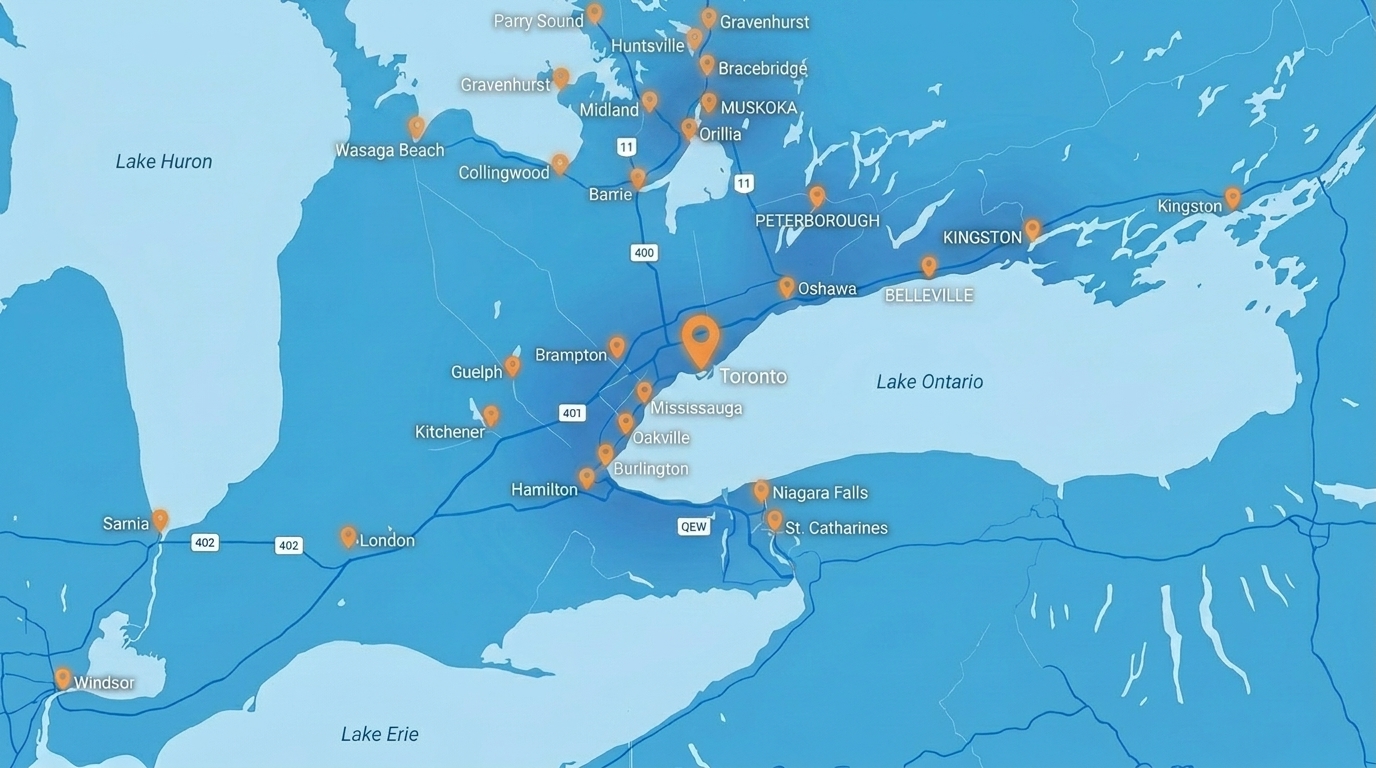
Across Toronto, Mississauga, Brampton, Vaughan, Hamilton, Barrie, and Southern Ontario, Sprayfoam Solutions Toronto Inc. dispatches Caliber Certified (CAN/ULC-S705.2 Licensed) Commercial Spray Foam Installers to eliminate steel building sweating permanently. By spraying 2 lb medium-density closed-cell spray polyurethane foam (CAN/ULC-S705.1) directly onto the interior steel skin, we eliminate the air gap behind failed fiberglass blankets, encapsulate cold Z-purlins, and lock out moisture in a single mobilization. Looking for full building size pricing (30x40 to 100x200)? See our companion Spray Foam Insulation for Metal Buildings Cost Guide or Get a $250 Credit on Your Estimate — Check Your Price in 60 Seconds (/price-chat) • No Site Visit Required.
Compare our 3 engineered closed-cell spray foam condensation solutions for Ontario steel buildings, warehouses, and shops:
- Stops roof dripping & fastener sweating in semi-heated storage buildings
- Includes $250 Estimate Credit
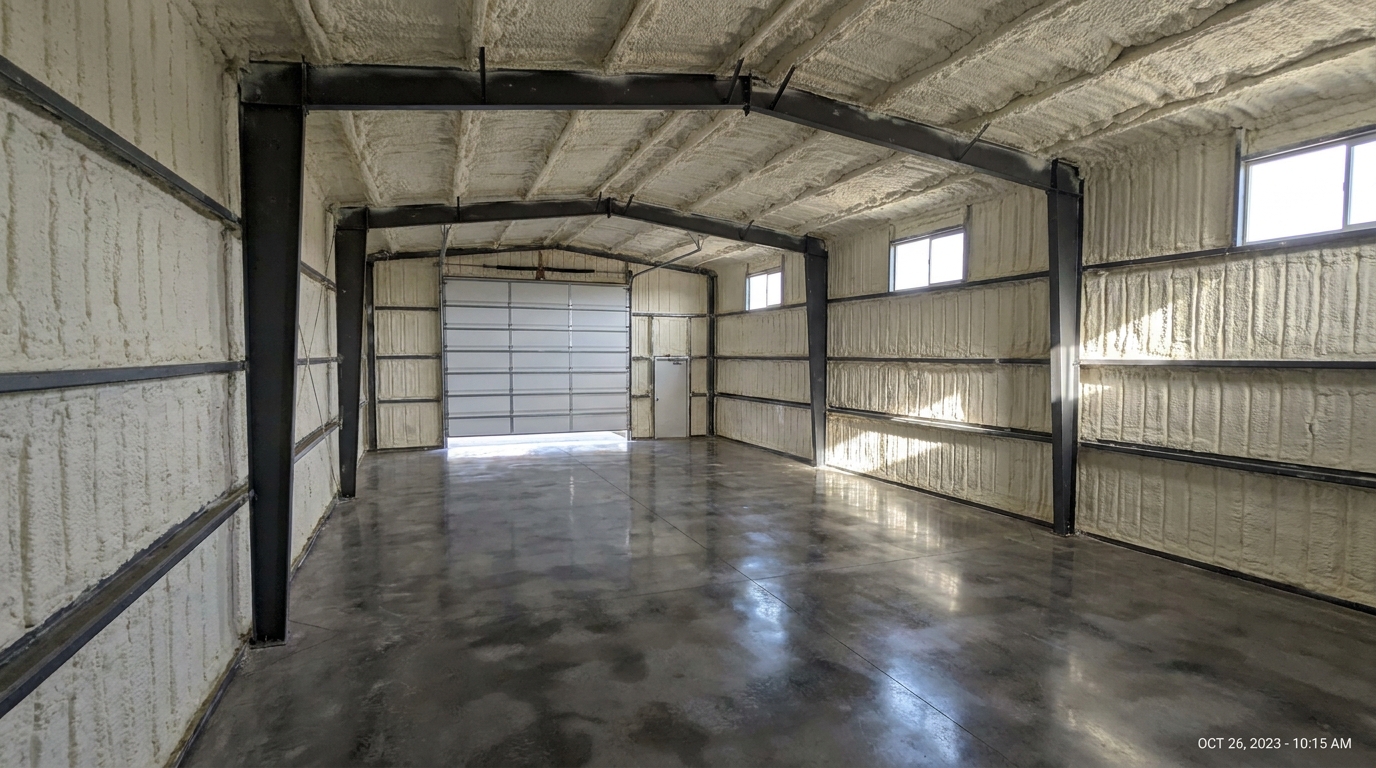
- 3"–3.5" Closed-Cell 2 lb on Steel Panels & Purlins
- Cuts heating bills 35%–50%
- Includes $250 Credit
- For high-moisture warehouses, truck wash bays & agricultural barns
- Includes $250 Estimate Credit
The Dew-Point Science Behind "Indoor Rain" & Sweating Steel Roofs in Ontario
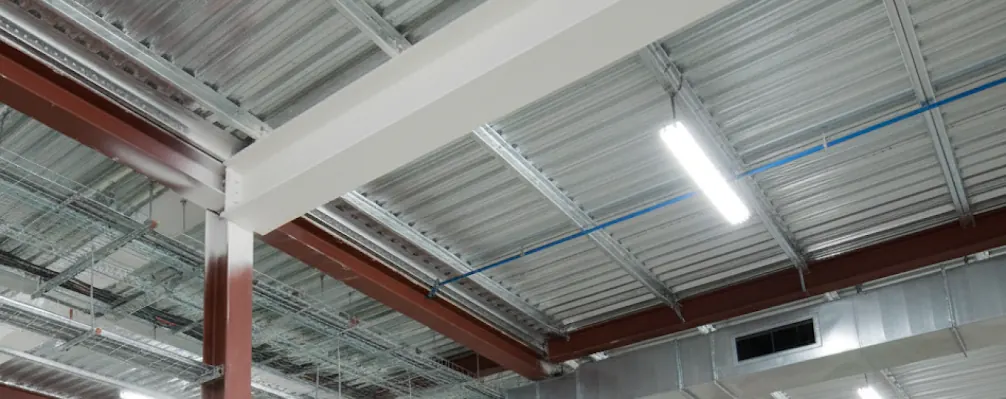
Steel conducts thermal energy roughly 400 times faster than wood. When outdoor winter temperatures in Ontario plunge to -15°C to -25°C and your warehouse insulation or shop heater warms the interior air to +15°C to +20°C, the interior face of bare or fiberglass-draped 26-gauge corrugated steel drops well below the indoor dew point temperature. The moment warm air carrying moisture from propane forklifts, vehicles, snowmelt on concrete floors, livestock, or human respiration touches that freezing metal skin, water vapour flashes into liquid droplets—raining down from roof peaks, Z-purlins, and screw heads.
| Building Environment & Indoor Relative Humidity (RH) | Minimum Closed-Cell Foam Depth Needed | Achieved R-Value & Vapour Rating | 2026 Installed Cost (/sq ft) | Condensation & Building Code Outcome |
|---|---|---|---|---|
Semi-Heated Storage / Cold Shop(25%–35% RH) | 1.5" – 2.0" Closed-Cell 2 lb | R-9 to R-12 (Class 1 Seal at 2.0") | $2.50 – $3.35 / sq ft | Stops Roof Panel Dripping & Freeze-Thaw Sweat |
Heated Mechanic Shop / Commercial Warehouse(35%–50% RH) | 3.0" – 3.5" Closed-Cell 2 lb | R-18 to R-21 (<60 ng/Pa·s·m²) | $3.40 – $4.65 / sq ft | Passes OBC Wall Code + 100% Dew-Point Elimination |
Commercial Roof Deck Assembly(40%–55% RH) | 4.0" – 5.0" Closed-Cell 2 lb | R-24 to R-30 Monolithic Roof Seal | $4.20 – $5.60 / sq ft | Stops Peak Roof Condensation & Ice Damming |
High-Moisture Truck Wash Bay / Agricultural Barn(60%+ RH) | 3.5" – 4.5" Closed-Cell 2 lb | R-21 to R-27 Waterproof Barrier | $3.85 – $5.15 / sq ft | Handles High Steam, Washdown & Livestock Humidity |
Shipping Container / Sea-Can Mod(30%–50% RH) | 2.0" – 3.0" Closed-Cell 2 lb | R-12 to R-18 Corten Steel Bond | $2.85 – $4.10 / sq ft | Eliminates Sea-Can Ceiling Sweat Permanently |
DC315 Intumescent Fire Coating Add-On(Commercial Code) | 18 Wet Mils(12 Dry Mils) | CAN/ULC-S102 / 15-Min Rating | +$1.00 – $1.75 / sq ft | Satisfies OBC Section 3.1.5 / 9.10.17.10 |
1.5"–2" Dew-Point Vapour Seal vs. 3"–3.5" (R-21) Full Thermal Envelope: Which Depth Do You Need?
One of the most common engineering questions we answer for facility managers comparing warehouse insulation cost in Ontario is whether a thin "flash coat" of spray foam is enough to stop condensation. The answer depends on how you heat and use the building. In a semi-heated drive shed or storage building kept just above freezing, 2.0 inches of 2 lb closed-cell spray foam (R-12) raises the interior surface temperature above the dew point AND qualifies as a certified Class 1 vapour barrier (<60 ng/Pa·s·m²). However, for fully heated commercial warehouses, workshops, and agricultural barn insulation kept at 16°C–21°C, specifying 3.0 to 3.5 inches on walls (R-18 to R-21) and 4.0 to 5.0 inches on roof decks (R-24 to R-30) is essential to prevent purlin thermal bridging during -25°C Ontario cold snaps while cutting winter gas bills by 35% to 50%.
Why Corrugated Steel Roofs, Z-Purlins & Fasteners Sweat First (5 Hidden Damage Risks)
When facility managers ignore winter ceiling dripping in a metal warehouse, pole barn, or shipping container workspace, the moisture triggers five compounding structural and financial hazards:
- 1. Galvanized Zinc Depletion & Structural Purlin Rust: Cold-formed steel Z-purlins, C-girts, and self-tapping roof screws corrode rapidly when subjected to 5 months of winter condensation. We regularly inspect 12-to-15-year-old Ontario steel buildings where trapped moisture behind wet fiberglass has eaten away 20% to 30% of the structural purlin cross-section.
- 2. "Indoor Rain" Along Roof Peaks & Fastener Rows: During daytime solar warm-ups in January and February, frost frozen to the underside of uninsulated metal roof decks melts all at once—pouring rusty water directly onto CNC machinery, electrical switchgear, palletized cardboard, and customer inventory.
- 3. Propane Forklift, Wash-Bay & Snowmelt Humidity Spikes: Every pound of propane burned by an indoor warehouse forklift releases 1.6 pounds of water vapour into the air, while snow melting off parked trucks turns the concrete slab into a humidifier—accelerating roof sweating exponentially.
- 4. Wet Concrete Floor Slip-and-Fall WSIB Liabilities: Condensation dripping from overhead purlins forms slick puddles and black ice near loading docks and pedestrian aisles, creating severe forklift skidding and worker slip hazards.
- 5. 40% to 60% Wasted Natural Gas & Propane Heating Costs: Latent heat loss from continuous condensation-and-evaporation cycles forces overhead radiant tube heaters and unit heaters to run non-stop, wasting thousands of dollars every winter.

Why Vinyl-Backed Fiberglass Blankets (MBI) & Bubble Foil Fail to Stop Metal Building Condensation
Many pre-engineered metal buildings (PEMBs) in Ontario were originally erected with draped fiberglass blanket insulation (MBI) or thin reflective bubble-foil wrap. Neither system stops dew-point condensation because neither system bonds to the corrugated steel ribs. Even a 1-millimetre air pocket between the insulation and the cold steel skin acts as a condensing chamber:
| Performance Metric | 2 lb Closed-Cell Spray Foam (CAN/ULC-S705.1) | Vinyl-Backed Fiberglass Blankets (MBI) | Reflective Foil Bubble Wrap | Ontario Condensation Verdict |
|---|---|---|---|---|
Adhesion to Corrugated Steel | 100% Direct Chemical Bond(Zero Air Gap) | Draped loosely; leaves air pockets in ribs | Stapled/taped; air gap behind every rib | Only Spray Foam Eliminates Condensing Surface |
Thermal Resistance(R-Value) | R-6.0 per inch (R-18 to R-30 typical) | R-3.1 per inch(Drops to <R-3 when wet) | R-1.1 to R-1.5 real conductive R-value | Bubble Foil Cannot Prevent Winter Dew Point |
Vapour Barrier Rating | Class 1 Vapour Barrier at ≥2.0"(<60 ng) | Seams leak at every purlin, girt & fastener | Tape seams peel in -20°C winter swings | Monolithic Seamless Seal Required |
Purlin & Girt Thermal Bridging | Encapsulates Z-Purlins & C-Girts Completely | Compressed to <0.5" over purlin flanges | Leaves steel framing exposed to cold | Stops Purlin Drip Lines Permanently |
Moisture & Rust Prevention | Waterproof Closed Cells Lock Out Rust | Traps condensation against steel panels | Sweats heavily on both faces in winter | Protects 40-Year Steel Building Lifespan |
Ontario Building Code (OBC), Class 1 Vapour Barrier & DC315 Thermal Barrier Rules for Steel Buildings
When retrofitting or insulating a commercial, industrial, or agricultural steel building under the 2026 Ontario Building Code (OBC Part 3, Part 9 & SB-10/SB-12) (see our Commercial Building Envelope Ontario Guide), your insulation assembly must satisfy three code pillars: continuous thermal performance, vapour diffusion control, and fire protection.
Because CAN/ULC-S705.1 CCMC-evaluated 2 lb closed-cell foam is an air-impermeable Class 1 vapour retarder at 2 inches, building inspectors across Ontario approve it without any plastic sheet vapour barrier. Furthermore, because hanging drywall on 24-to-35-foot warehouse ceilings is impractical, we apply DC315 intumescent fire coating (+$1.00–$1.75/sq ft) directly over the cured spray foam during the same mobilization to provide a certified 15-minute thermal barrier (learn more in our DC315 Fire Coating Guide and Ignition vs. Thermal Barrier Guide).

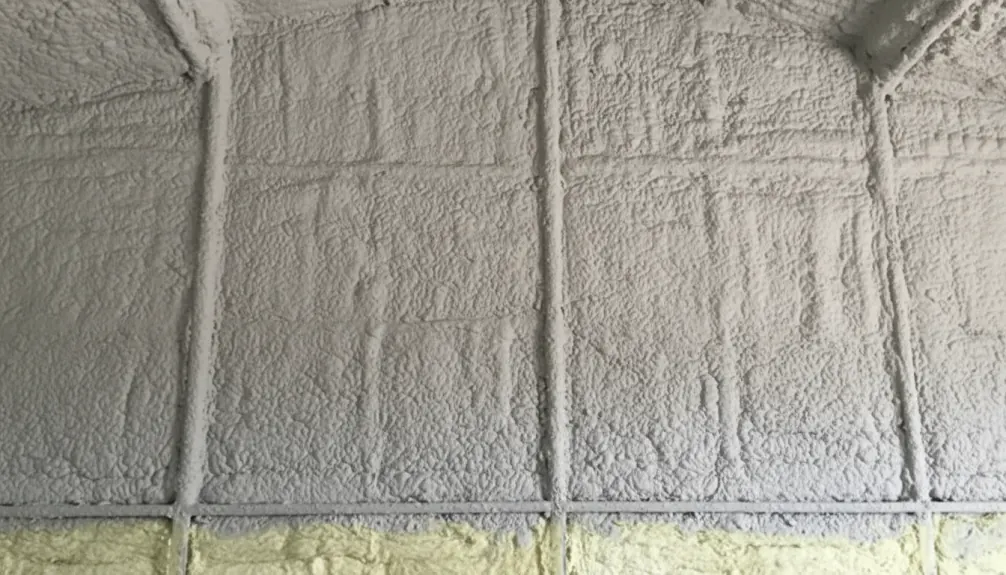
Bonds directly into corrugated steel wall ribs.
Fills corrugated flutes & seals panel lap seams.
Eliminates wall sweating, wind drafts & rust.
Corrugated 26-gauge steel wall panels transfer outdoor freezing temperatures directly indoors. Spraying 2.5" to 3.5" of CAN/ULC-S705.1 2 lb closed-cell foam directly onto clean steel fills every rib contour, locks panel lap joints against wind-driven rain, and forms a Class 1 vapour barrier (<60 ng/Pa·s·m²) so indoor humidity can never touch cold metal.
6 Critical On-Site Rules for Spraying Sweating Metal Buildings in Ontario
Spraying polyurethane foam onto corrugated steel in an Ontario warehouse or agricultural barn requires strict substrate preparation under CAN/ULC-S705.2. Our Caliber Certified installers follow six non-negotiable field protocols:
- 1. Strip Wet Vinyl-Backed Fiberglass Blankets First ($0.75–$1.50/sq ft Tear-Out): Never spray closed-cell foam over soggy, sagging fiberglass blankets. Trapping wet fiberglass against steel panels accelerates hidden corrosion and causes delamination. We strip and dispose of failed MBI blankets so fresh 2 lb foam bonds directly to bare steel.
- 2. Steel Surface Temperature, Dew-Point Margin (+3°C) & Degreasing Prep: Steel panels cannot be sprayed while actively wet or covered in frost. Our crew uses industrial infrared heaters and dehumidifiers to bring steel substrate temperatures at least 3°C (5°F) above the interior dew point, and solvent-wipes mill oil or exhaust grease prior to spraying.
- 3. Rust Priming & Fastener Inspection Before Encapsulation: If existing condensation has caused surface oxidation on purlins or panel seams, we wire-brush loose scale and check that self-tapping EPDM roof washer screws are watertight before locking the roof deck in closed-cell foam.
- 4. Multi-Pass Lift Technique (Maximum 2.0" Per Pass to Prevent Scorching): Spraying more than 2 inches of closed-cell foam in a single pass traps exothermic chemical heat, which can oil-can thin 26-gauge metal panels or pull foam away from steel ribs. We spray in controlled 1.0" to 2.0" passes for a rock-solid bond.
- 5. Corrugated Rib Profile Factor (+12% to +18% Surface Area Math): Unlike flat drywall, corrugated steel siding and roof decks have trapezoidal ribs and 8-inch Z-purlins that increase actual sprayable surface area by 12% to 18% over flat footprint dimensions—already factored into our transparent quotes.
- 6. Mechanical Ventilation & Dehumidification After Air-Sealing: Once your metal building is 100% air-sealed with closed-cell foam, indoor moisture from wash bays, forklifts, or livestock can no longer escape through panel gaps. We help you coordinate proper HRV/exhaust ventilation so indoor relative humidity stays between 30% and 45%.

Same-Week Metal Building Spray Foam Dispatch Across Toronto, GTA & Ontario ($0 GTA Travel Fee)
Every commercial mobile trailer rig is self-contained with onboard diesel generators, high-output Graco proportioners, heated hose lines, and scissor lifts—operated by Caliber Certified (CAN/ULC-S705.2 Licensed) Commercial Spray Foam Installers. We charge $0 Travel Fee across Toronto and the GTA and schedule night or weekend shifts so your warehouse or shop never loses a production day.

We verify steel substrate moisture, purlin profile depth, and schedule around your warehouse or shop hours.

Our team strips wet fiberglass if present, masks overhead cranes, doors, lighting, and floors against overspray.

Multi-pass application of 2 lb closed-cell spray foam to corrugated panels, Z-purlins, and C-girts.

Optional DC315 intumescent fire coating application, full site cleanup, and CAN/ULC-S705.2 warranty card issue.
Frequently Asked Questions: Stopping Metal Building Condensation in Ontario
In Ontario, 1.5 to 2.0 inches of 2 lb closed-cell spray foam (CAN/ULC-S705.1) is the minimum thickness required to stop surface condensation in unheated or semi-heated metal buildings, because 2.0 inches creates a certified Class 1 vapour barrier (<60 ng/Pa·s·m²). For fully heated commercial warehouses, mechanic shops, and barns kept at 15°C to 21°C, we recommend 3.0 to 3.5 inches on steel walls (R-18 to R-21) and 4.0 to 5.0 inches on metal roof decks (R-24 to R-30) to prevent dew-point sweating during -25°C cold snaps.
In 2026, applying 2 lb closed-cell spray foam to stop metal building condensation in Ontario costs $2.50 to $3.35 per sq ft for a 1.5"–2.0" anti-sweat vapour seal, or $3.40 to $4.65 per sq ft for a full 3.0"–3.5" (R-18 to R-21) heated commercial envelope installed by Sprayfoam Solutions Toronto Inc. (Caliber Certified & CAN/ULC-S705.2 Licensed). You can Get a $250 Credit on Your Estimate — Check Your Price in 60 Seconds (/price-chat) • No Site Visit Required or call (647) 333-3626.
No—spraying closed-cell foam over damp, sagging vinyl-backed fiberglass blankets (MBI) is a critical mistake. Because the existing fiberglass does not adhere to the corrugated steel panels, moist air continues to circulate and condense behind the blanket, rotting the steel purlins and panels out of sight. Our Caliber Certified crew strips away the old fiberglass ($0.75–$1.50/sq ft), inspects the steel for corrosion, and sprays directly onto the clean metal substrate.
Winter roof dripping ("indoor rain") happens when warm, humid indoor air rises to the uninsulated or poorly sealed corrugated metal roof deck and cools below its dew point, freezing into layers of hoarfrost overnight. As soon as the morning sun warms the exterior metal roof—or your shop heaters cycle on—that accumulated frost melts rapidly and drips from every Z-purlin and screw line. Direct-applied 2 lb closed-cell spray foam eliminates the cold metal condensing surface permanently.
No—properly installed CAN/ULC-S705.1 2 lb closed-cell spray foam actually prevents steel panel corrosion. Because closed-cell foam is waterproof, air-impermeable, and bonds with zero air gap to clean, dry steel, oxygen and warm indoor water vapour can never reach the interior metal face. Before spraying, our Caliber Certified (CAN/ULC-S705.2 Licensed) Commercial Spray Foam Installers verify that existing roof screw washers are watertight and the steel surface is dry.
Yes. Under the Ontario Building Code (OBC Section 3.1.5 and Section 9.10.17.10), spray polyurethane foam in commercial, industrial, and most occupied buildings must be protected by a 15-minute thermal barrier. We spray DC315 intumescent fire coating (+$1.00–$1.75/sq ft) directly over the cured foam during the same mobilization, preserving full ceiling headroom while delivering a bright white, code-compliant finish.
Insulating the steel walls, girts, and roof deck with 2 lb closed-cell spray foam eliminates 100% of overhead ceiling dripping onto the concrete slab and stabilizes indoor ambient temperatures, which drastically reduces floor dampness. If your concrete slab still sweats during humid summer weather due to cold ground temperatures beneath an uninsulated slab, pairing perimeter wall foam with high-volume ceiling destratification fans or dehumidification resolves slab sweating.
Our high-output commercial mobile trailer rigs apply 3,000 to 6,000+ sq ft of closed-cell spray foam per day, allowing a typical 10,000 to 15,000 sq ft metal building to be completed in 2 to 4 days (plus 1 day for DC315 fire coating). We offer flexible evening and weekend shifts across Toronto, the GTA, and Southern Ontario—call (647) 333-3626 or visit spfsolutions.ca/price-chat to claim your $250 Estimate Credit.
Select your steel building application or municipality below for local Ontario Building Code specs and commercial rig availability: