How Much Does Basement Spray Foam Insulation Cost in Ontario? (2026 Price Per Sq Ft & Ontario Building Code Guide)

Planning basement wall insulation or fixing a cold basement insulation problem in Toronto, the GTA, or anywhere in Ontario is completely different from insulating an above-grade room. Poured concrete, hollow cinder block, and century-home rubble foundation walls sit directly against damp, freezing soil for five months of the year—meaning if you trap humid indoor air behind traditional fiberglass batts prior to hanging basement drywall insulation, condensation and hidden black mould form against the cold concrete within a single winter.
That is why 85%+ of Ontario basement renovations, legal second suites, and custom homes now use 2 lb medium-density closed-cell spray polyurethane foam (CAN/ULC-S705.1) installed by Sprayfoam Solutions Toronto Inc.—with Caliber Certified (CAN/ULC-S705.2 Licensed) installers across Toronto, the GTA, and Southern Ontario. In one single pass, closed-cell spray foam bonds directly to concrete, brick, or wood framing, stops air leakage at the rim joists, delivers R-20 to R-24 thermal resistance, cuts annual winter heating bills by 15% to 25% ($400–$750/year), and serves as your code-approved Class 1 vapour barrier.
Compare our 3 most common GTA & Ontario residential basement scopes before checking your exact square-foot price:
- 3"–3.5" Closed-Cell 2 lb (R-20+)
- Stops 40% of floor drafts & insects
- Includes $250 Estimate Credit
- 3.5"–4" Closed-Cell 2 lb (R-21 to R-24)
- Walls + Rim Joists + Vapour Barrier
- Passes Ontario Building Code
- 3.5"–4" Closed-Cell 2 lb Foundation
- Optional Ceiling Soundproofing
- Includes $250 Estimate Credit
2026 Basement Spray Foam Cost Per Square Foot in Ontario (By R-Value & Depth)
Spray foam insulation is priced by board foot (1 square foot at 1 inch thick). For Ontario basements in 2026, our turnkey installed rate for 2 lb closed-cell spray foam (CAN/ULC-S705.1) averages $1.10 to $1.45 per board foot—meaning the spray foam insulation cost for 1000 sq ft of basement wall area ranges from $2,800 to $4,600 CAD complete with surface prep, poly masking, negative-pressure exhaust venting, certified installation, cleanup, and your municipal inspection warranty card.
| Basement Zone / Application | Recommended Foam Depth & R-Value | 2026 Installed Cost (/sq ft) | Typical Total Project Cost | Ontario Building Code Status |
|---|---|---|---|---|
| Rim Joists / Sill Box Headers | 3.0" – 3.5" Closed-Cell (R-18 to R-21) | $3.25 – $4.85 / lin. ft. | $1,250 – $2,100 | Air Barrier + Vapour Barrier Seal |
| Concrete Foundation Walls (Code Minimum) | 3.5" Closed-Cell 2 lb (R-21 Continuous) | $3.30 – $4.25 / sq ft | $2,800 – $4,100 (800–1,000 sq ft wall) | Passes Ontario Building Code R-20 Rule |
| Framed 2x4 Basement Stud Walls | 4.0" Closed-Cell 2 lb (R-24 Cavity) | $3.80 – $4.85 / sq ft | $3,400 – $4,600 (800–1,000 sq ft wall) | Passes Ontario Building Code R-24 Rule |
| Cold Room / Cantina Under Porch | 3.5" – 4.0" Closed-Cell 2 lb (R-21 to R-24) | $3.50 – $4.85 / sq ft | $850 – $2,100 | Stops Porch Slab Sweating & Pipe Freeze |
| Under Concrete Slab / Radiant Floor | 2.0" – 3.5" Closed-Cell 2 lb (R-12 to R-21) | $2.50 – $4.10 / sq ft | $2,200 – $3,900 | High Compressive Strength (>25 PSI) + Radon Barrier |
| Basement Ceiling Soundproofing (Between Floors) | 3.5" – 5.5" Open-Cell 0.5 lb (R-14 to R-20) | $1.75 – $2.85 / sq ft | $1,600 – $2,800 | Acoustic Dampening for Legal Basement Apartments |
| Crawl Space / Walkout Foundation Walls | 3.0" – 3.5" Closed-Cell 2 lb (R-18 to R-21) | $3.20 – $4.35 / sq ft | $1,500 – $2,900 | Seals Damp Crawl Spaces & Stops Floor Chills |
Spray Foam Cost for 1,000 Sq Ft in Ontario (2026 Worked Examples)
Homeowners searching for spray foam cost for 1,000 sq ft are usually pricing a standard 1,000 sq ft basement floor footprint (~125 to 135 linear feet of exterior foundation perimeter × 8 ft ceiling height = ~850 to 1,000 sq ft of net sprayable wall area after subtracting windows and utility panels). Here is the exact 2026 worked-example breakdown for 1,000 sq ft across every thickness and basement package:
| 1,000 Sq Ft Worked-Example Scope | Total Board Feet | Foam Spec & R-Value | 2026 Installed Price | Net Cost After $250 Credit |
|---|---|---|---|---|
| 1,000 Sq Ft @ 2.0" Depth (Under-Slab / Moisture & Vapour Seal) | 2,000 bd ft | 2.0" Closed-Cell 2 lb (R-12 + Class 1 Vapour Barrier) | $2,500 – $3,100 | $2,250 – $2,850 |
| 1,000 Sq Ft Basement @ 3.5" Depth (OBC R-20 Continuous Code Pass) | 3,000 – 3,500 bd ft | 3.5" Closed-Cell 2 lb (R-21 Walls + Rim Joists Included) | $2,800 – $4,100 | $2,550 – $3,850 |
| 1,000 Sq Ft Basement @ 4.0" Depth (OBC R-24 Framed Stud Cavity) | 3,400 – 4,000 bd ft | 4.0" Closed-Cell 2 lb (R-24 Walls + Rim Joist Seal) | $3,400 – $4,600 | $3,150 – $4,350 |
| 1,000 Sq Ft Ceiling Soundproofing (Between Floors Only) | 3,500 – 5,000 bd ft | 3.5"–5.0" Open-Cell 0.5 lb (STC 50+ Acoustic Ceiling) | $1,750 – $2,800 | $1,500 – $2,550 |
| 1,000 Sq Ft Full Legal Basement Apartment Package (Walls + Rim + Ceiling) | Walls + Ceiling | 3.5" Closed-Cell Walls (R-21) + 5" Open-Cell Ceiling | $4,400 – $6,600 | $4,150 – $6,350 |
Rim Joist & Header Sealing Cost (Why It Stops 40% of Basement Drafts)
Where your wooden floor joists rest on top of the poured concrete foundation wall (the rim joist or header box) is the #1 source of cold drafts, spiders, mice, and heat loss in an Ontario house. Stuffing pink fiberglass into rim joists traps moisture against cold exterior brick or siding and rots the wood sill plate. Spraying 3 to 3.5 inches of 2 lb closed-cell foam permanently seals every gap, nail hole, and sill-plate joint in a single afternoon.

Under-Slab, Crawl Space & Foundation Substrate Pricing (Poured Concrete vs. Cinder Block vs. Century Rubble)
In addition to full-height walls and crawl space spray foam encapsulation, the physical texture of your foundation wall directly affects board-foot chemical consumption:
- Smooth Poured Concrete Walls (1965–2026 Subdivisions — $3.30 to $4.25/sq ft): Smooth form-tied concrete requires zero surface profiling overage (0%–5% waste factor), achieving R-21 continuous thermal performance at 3.5 inches.
- Hollow-Core Cinder Block / CMU Foundations (1920s–1970s Bungalows — $3.50 to $4.50/sq ft): Porous concrete masonry blocks have recessed mortar joints and open top cores that convect cold air. Closed-cell 2 lb foam bonds directly to CMU block, seals the top block cores at the sill plate, and stops damp block sweating (+10% chemical yield).
- Century-Home Rubble Stone, Fieldstone & Brick (Toronto Annex, Beaches, High Park, Cabbagetown — $3.85 to $4.85/sq ft): Wavy 100-year-old stone and mortar walls vary by 2" to 4" in depth (+15%–20% board-foot contour allowance). Closed-cell spray foam expands into every mortar pocket, structurally locking loose masonry while stopping earth odours.
- Under-Slab Radiant Floors & Basement Lowering ($2.50 to $4.10/sq ft): When underpinning a Toronto basement or installing hydronic radiant heat, spraying 2 to 3.5 inches of high-compressive-strength (>25–30 PSI) closed-cell foam directly over the compacted gravel base forms a monolithic thermal break and Radon gas barrier under the new concrete slab.
- Old Fiberglass & Poly Vapour Barrier Tear-Out (Optional Add-On — $0.75 to $1.50/sq ft): If your basement currently has damp builder-grade fiberglass blanket insulation or mouldy wood strapping, our crew can strip, bag, and dispose of the old batts ($600–$1,400 typical full-basement tear-out) so fresh closed-cell foam bonds directly to bare concrete.

What Is the Ontario Building Code Requirement for Basement Insulation in 2026?
When researching basement insulation code ontario requirements, homeowners and general contractors must comply with 2026 Ontario Building Code Part 9 and Supplementary Standard SB-12 (detailed in our complete Ontario Basement Insulation Code Guide). Full-height basement foundation walls in Ontario Climate Zone 1 (Toronto, GTA, Hamilton, Niagara, London, Barrie) and Zone 2 require either R-20 continuous insulation (RSI 3.52) or R-24 cavity insulation (RSI 4.23) within framed stud walls from the top of the foundation wall all the way down to the basement slab.
Why 2 lb Closed-Cell Spray Foam Acts as Insulation + Vapour Barrier in One
When you insulate a basement with fiberglass or mineral wool batts, the Ontario Building Code requires a continuous 6-mil polyethylene vapour barrier sealed with acoustic sealant over the studs. Any staple hole, electrical box cutout, or unsealed seam allows warm household air to hit the freezing concrete wall behind the batts. At 2 inches or thicker, CAN/ULC-S705.1 CCMC-evaluated closed-cell spray foam is certified as an air barrier AND a Type II / Class 1 vapour barrier—saving you the material and labour cost of installing plastic poly sheeting while guaranteeing your municipal building inspector signs off on the first visit.
Ontario Building Code Thermal Barrier Rule (1/2" Drywall Coverage)
Under Ontario Building Code Section 9.10.17.10, spray polyurethane foam cannot be left permanently exposed in a habitable basement. Once your Caliber Certified crew finishes spraying the foundation walls and rim joists and the municipal building inspector signs off on the insulation depth and daily lot sheet, your drywaller installs standard 1/2-inch gypsum drywall over the framing to serve as the required 15-minute thermal barrier.
Insulation + Class 1 vapour barrier in one pass.
Continuous depth behind & between 2x4 studs.
Stops soil moisture, radon & thermal bridging.
Below-grade concrete foundation walls sit against damp, freezing soil. Applying 3.5" to 4.0" of CAN/ULC-S705.1 2 lb closed-cell spray foam directly onto the concrete and behind the 2x4 framing creates a monolithic air seal and Class 1 vapour barrier (<60 ng/Pa·s·m²)—eliminating separate 6-mil poly sheeting and passing Ontario Building Code R-20/R-24 inspection on the first visit.
6 Critical On-Site Trade Rules Before Spraying an Ontario Basement (Framing, Wiring, Moisture & Cold Rooms)
After 18+ years of spraying thousands of residential basements across Toronto and Southern Ontario, our Caliber Certified estimators check six real-world site details that generic contractors overlook:
- 1. Stand 2x4 Wood Studs 1" to 1.5" Off the Concrete Wall (Zero Thermal Bridging): Never press wood framing flat against damp below-grade concrete. Standing your 2x4 frame 1 to 1.5 inches off the foundation wall allows our sprayers to inject a continuous monolithic blanket of 2 lb closed-cell foam behind every wood stud—preventing wood rot, eliminating thermal bridging, and satisfying Ontario Building Code R-20 continuous insulation rules inside standard 2x4 framing.
- 2. Complete Electrical & Plumbing Rough-Ins BEFORE Spray Foam Day (ESA Compliance): All electrical boxes, Romex wiring, pot-light feeds, and PEX water lines must be roughed in and inspected by the Electrical Safety Authority (ESA) before we spray. Closed-cell foam locks cables securely in place and seals around every electrical outlet box so you are 100% ready for basement drywall insulation board-up.
- 3. Concrete Moisture (<18%), Efflorescence & Foundation Crack Check: Spray foam is a waterproof air and vapour barrier, not a structural patch for an active groundwater leak. Before spraying, our crew inspects the concrete for white powdery efflorescence or active seepage cracks, verifies substrate moisture is below 18%, and uses heated proportioner hoses so chemical core temperatures remain optimal even when outside temperatures drop to -20°C.
- 4. Century-Home Rubble, Fieldstone & Brick Foundations (Toronto Annex, Beaches, High Park, Cabbagetown): Rigid foam boards and fiberglass batts cannot sit flat against wavy 100-year-old rubble stone or mortar-joint brick foundations, leaving hollow condensation pockets behind the wall. Closed-cell 2 lb spray foam expands into every mortar joint and stone contour, structurally stabilizing older Toronto foundations while sealing out damp earth odours.
- 5. Cold Room / Cantina Insulation Under Concrete Front Porches ($850 – $2,100 Installed): Uninsulated concrete cantinas (fruit cellars) under front porches sweat in summer, grow black mould on the ceiling slab, and freeze adjacent kitchen floors in winter. We insulate cold room walls, overheads, and steel bulkhead doors with 3.5"–4" of closed-cell spray foam (cold room insulation) to convert damp cantinas into clean, dry conditioned storage.
- 6. Legal Basement Apartment Soundproofing (STC 50+) Between Floors: While closed-cell 2 lb foam belongs on exterior concrete foundation walls and rim joists, between-floor basement ceilings perform best with 3.5" to 5.5" of 0.5 lb open-cell acoustic spray foam (see our Spray Foam vs. Rockwool Soundproofing Guide) paired with resilient sound channels and 5/8" Type X drywall to deaden footsteps and pass municipal duplex inspections.

Closed-Cell Spray Foam vs. Fiberglass Batts & Rigid Board in Ontario Basements
Homeowners comparing quotes in our 2026 Ontario Spray Foam Cost Guide often ask whether fiberglass batts or XPS rigid foam boards are cheaper. Once you factor in framing adjustments, 6-mil poly vapour barrier installation, taping seams, and rim-joist air sealing, closed-cell spray foam is the only permanent, flood-resistant solution built for below-grade concrete:
| Feature / Performance Metric | 2 lb Closed-Cell Spray Foam (CAN/ULC-S705.1) | Fiberglass / Mineral Wool Batts + 6-Mil Poly | XPS Rigid Foam Board + Tape |
|---|---|---|---|
| R-Value Per Inch | R-6.0 / inch (R-21 in 3.5") | R-3.2 to R-3.7 / inch (Requires thicker framing) | R-5.0 / inch (Requires flat concrete walls) |
| Built-In Vapour Barrier | Yes — Class 1 Vapour Barrier at 2"+ | No — Requires separate 6-mil poly & sealant | Only if every board seam & edge is taped |
| Air & Radon Gas Sealing | 100% Monolithic Air & Soil-Gas Seal | 0% Air Seal (Air passes right through batts) | Leaks behind wavy/uneven poured concrete |
| Moisture & Mould Resistance | Waterproof & Zero Food Source for Mould | Absorbs condensation; sags & grows mould | Boards resist water, but cavities behind trap dampness |
| Rim Joist Sealing Included | Sprayed seamlessly in the same pass | Difficult to cut/seal around pipes & wires | Requires hand-cutting & can-foaming every bay |
| 2026 Installed Cost (1,000 Sq Ft) | $2,800 – $4,600 (Minus $250 Credit) | $2,100 – $3,300 (+ high risk of moisture rework) | $3,100 – $4,800 (Labour-intensive board cutting) |
Same-Week Basement Spray Foam Installation Across Toronto & the GTA ($0 Travel Fee)
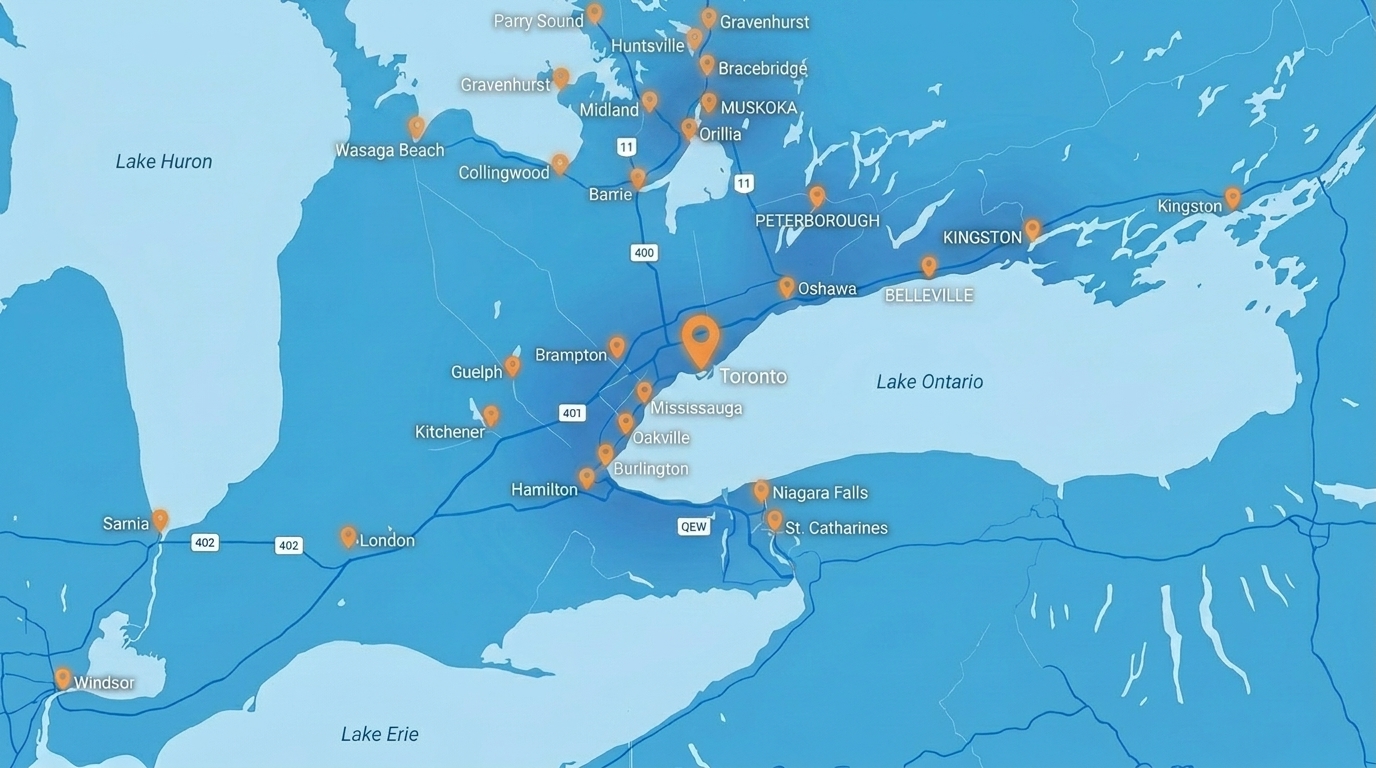
Every residential and commercial mobile rig is dispatched with Caliber Certified (CAN/ULC-S705.2 Licensed) spray foam installers. We charge $0 Travel Fee across Toronto and surrounding GTA municipalities (Mississauga, Brampton, Vaughan, Markham, Oakville, Burlington, Hamilton, Pickering, Ajax, Whitby, Oshawa, and Barrie), and our rigs carry heated hoses and onboard generators to spray year-round.

We coordinate with you to schedule around electrical and plumbing trades.

Our team arrives to mask windows, doors, and floors, ensuring zero overspray residue.

Precision spraying of specified closed-cell thickness to walls, rim joists, and ceilings.

Scraping excess foam flush, cleaning the site, and preparing for framing inspector sign-off.
Select your basement service scope or municipality below for local Ontario Building Code specs and same-week dispatch availability:
Frequently Asked Questions: Basement Spray Foam Cost in Ontario
In 2026, insulating the perimeter walls and rim joists of a standard 1,000 sq ft Ontario basement with 3.5 to 4 inches of 2 lb closed-cell spray foam (R-21 to R-24) installed by Sprayfoam Solutions Toronto Inc. (Caliber Certified & CAN/ULC-S705.2 Licensed) costs between $2,800 and $4,600 CAD ($2.50–$4.85 per sq ft) before applying your $250 Estimate Credit. You can see your exact on-screen ballpark price in 60 seconds using our online calculator at spfsolutions.ca/price-chat or by calling (647) 333-3626.
No. Once CAN/ULC-S705.1 medium-density 2 lb closed-cell spray foam is installed at a minimum thickness of 2 inches (50 mm) by a Caliber Certified (CAN/ULC-S705.2 Licensed) contractor like Sprayfoam Solutions Toronto Inc., it is certified under the Ontario Building Code as a Type II / Class 1 vapour barrier (<60 ng/Pa·s·m²). You do not need to purchase or install 6-mil polyethylene sheeting over closed-cell foam (learn more in our Basement Vapour Barrier Guide).
Homeowners and pets vacate during application and safely re-enter the home after the standard 24-hour occupancy window. During spraying, Sprayfoam Solutions Toronto Inc. seals the basement under negative air pressure using high-CFM industrial exhaust fans vented directly outdoors, and we spray low-VOC HFO-blown closed-cell foam systems (BASF Walltite® Eco v.3, Huntsman Building Solutions Icynene/Demilec, Johns Manville & other approved CCMC spray foam chemicals). Once cured at the 24-hour mark, 2 lb closed-cell polyurethane foam is chemically stable, fully cured, odourless, and does not off-gas into your living space.
Yes. Under Ontario Building Code Section 9.10.17.10, spray foam insulation in a residential basement must be protected by a 15-minute thermal barrier. Once our Caliber Certified crew completes your spray foam installation and your municipal building inspector signs off on the insulation depth and daily lot sheet, standard 1/2-inch gypsum drywall installed over the framing satisfies this code requirement.
Yes—2 lb closed-cell spray foam bonds tenaciously to poured concrete, hollow concrete cinder blocks (CMU), brick, and sound parging, and can be sprayed over tightly adhered flat latex or masonry paint. Before spraying a painted or block basement wall, our certified installers perform a substrate moisture test (must read below 18% moisture) and wire-brush away any flaking paint or chalky white efflorescence so the expanding foam forms a permanent monolithic bond.
Yes—sealing your basement rim joists, sill plates, and foundation walls with 2 lb closed-cell spray foam eliminates over 90% of insect and rodent entry points. Unlike pink fiberglass batts—which mice and spiders tear apart for nesting—cured 2 lb closed-cell foam hardens into a dense, rigid barrier (2.0 lbs/ft³) and eliminates the damp concrete condensation that attracts house centipedes, silverfish, and earwigs.
Yes—all existing fiberglass batts, mineral wool, and 6-mil polyethylene plastic must be stripped down to the bare concrete foundation wall before closed-cell spray foam can be applied under CAN/ULC-S705.2 installation standards. If your basement currently has damp or mouldy builder-grade fiberglass blanket insulation, our crew can include full tear-out, bagging, and disposal ($0.75–$1.50/sq ft) as part of your turnkey quote.
Yes—for below-grade concrete basements in Ontario, 2 lb closed-cell spray foam (CAN/ULC-S705.1) is overwhelmingly superior to fiberglass batts because it bonds directly to cold concrete, blocks soil moisture and radon gas, provides R-6.0 per inch (fitting R-21 to R-24 inside standard 2x4 framing), and cuts annual heating bills by 15% to 25% ($400–$750/year). While fiberglass + 6-mil poly costs $2,100–$3,300, closed-cell spray foam from Sprayfoam Solutions Toronto Inc. costs $2,800–$4,600 and permanently protects your basement renovation from moisture damage.
Sprayfoam Solutions Toronto Inc. (Serving Toronto, the GTA & Ontario • (647) 333-3626) is one of Ontario’s highest-rated (5.0 ★) certified spray foam insulation contractors. We dispatch Caliber Certified (CAN/ULC-S705.2 Licensed) spray foam installers, charge $0 Travel Fee across surrounding GTA cities, and provide an instant 60-second online estimate with a $250 Estimate Credit at spfsolutions.ca/price-chat.