ASTM E605 Density/Thickness & ASTM E736 Cohesion/Adhesion Testing for SFRM Fireproofing in Ontario (2026 GC QA Guide)
ASTM E605 Density/Thickness & ASTM E736 Cohesion/Adhesion Testing for SFRM Fireproofing in Ontario (2026 GC QA Guide): 2026 Ontario Overview & Code Essentials
For commercial general contractors, site superintendents, and structural engineers across Toronto, Mississauga, Brampton, Vaughan, Hamilton, and Ontario, applying cementitious fireproofing (SFRM) onto structural steel columns, wide-flange beams, and fluted floor decks is only half the battle. Before mechanical ductwork, suspended ceilings, or shaft-wall drywall can conceal the steel frame—and before the municipal building official grants partial or final occupancy under 2026 Ontario Building Code Division B Part 3—an independent third-party materials testing agency ( Pinchin, WSP, EXP, Englobe, or Terraprobe) must climb the lifts and perform destructive field audits under ASTM E605 (Thickness and Density of Sprayed Fire-Resistive Material) and ASTM E736 (Cohesion/Adhesion of Sprayed Fire-Resistive Materials Applied to Structural Members).
If an uncertified plaster crew over-waters the mixer, sprays over mill oil or incompatible shop primer, or shortcuts the W/D ratio thickness on a ULC D902 or ULC F906 assembly, a failed ASTM E605 / E736 field report triggers an immediate consultant deficiency hold—halting every follow-on trade on the floor. At Sprayfoam Solutions Toronto Inc., our Division 07 fireproofing teams and Caliber Certified (CAN/ULC-S705.2 Licensed) Installers execute internal pin-depth, core-density, and bond-pull verification on every bay, while also delivering intumescent structural steel coatings and our Single-Source Turnkey 2 lb SPF + 18-Mil DC315 Package with IFTI DC315 thermal barrier coating at exterior envelope tie-ins. Get a $250 Credit on Your Estimate — Check Your Price in 60 Seconds (/price-chat) • No Site Visit Required, or submit your structural tender through our General Contractor & B2B Estimating Desk.
Compare our 3 commercial Division 07 cementitious fireproofing and inspection remediation pricing tiers across Toronto & Ontario:
- Clears Failed ASTM E605 Thickness/Density or E736 Bond Holds
- Spatter-Coat Bond Adhesive + Monokote MK-6/Z-106 or Cafco 300/400
- -$250 Credit
- 1-Hr to 2-Hr CAN/ULC-S101 Assemblies (F906, D902, Z608)
- Guaranteed ASTM E605 (≥15/22 pcf) & E736 (≥200/430 psf) Field Pass
- Full Submittal Binder
- Monokote Z-106/Z-146 & Cafco 400 (≥430–1,000+ psf Bond) + Turnkey 2 lb Closed-Cell SPF & 18-Mil DC315 Envelope Transitions
- Priority GC Tender Rates
2026 Third-Party SFRM Field Testing Standards (ASTM E605 & E736) & Installed Cost Table in Ontario
In 2026, commercial Monokote MK-6 vs. Cafco 300 fireproofing in Ontario averages $2.25 to $4.10 per sq ft for standard 15 lb/ft³ gypsum-based SFRM, $3.15 to $5.25 per sq ft for medium-density 22 lb/ft³ Portland-cement SFRM, and $4.25 to $5.85+ per sq ft for 40 lb/ft³ high-density industrial SFRM. Every density class must satisfy specific minimum field metrics under CAN/ULC-S101, ASTM E605, and ASTM E736 before the project consultant signs off:
| SFRM Density Class & Approved Products | Minimum ASTM E605 Field Density (Avg / Ind) | Minimum ASTM E736 Cohesion / Adhesion Bond | 2026 Installed Rate (/sq ft) | Primary Ontario Building Code Application |
|---|---|---|---|---|
Standard-Density SFRM ( 15 pcf)(Monokote MK-6 HY / Cafco 300) | ≥15.0 lb/ft³ Avg( 240 kg/m³ • ≥14.0 pcf single) | ≥200 lbs/sq ft ( 9.5 kPa) Unexposed / Concealed | $2.25 – $4.10 / sq ft | Concealed Floor/Roof Decks & Beams( ULC F906, D902) |
Medium-Density SFRM ( 22 pcf)(Monokote Z-106 / Cafco 400) | ≥22.0 lb/ft³ Avg( 352 kg/m³ • ≥19.0 pcf single) | ≥430 lbs/sq ft ( 20.6 kPa) Exposed / Humid | $3.15 – $5.25 / sq ft | Underground Parkades, Mech Rooms & Elevator Shafts |
High-Density SFRM ( 40 pcf)(Monokote Z-146 / Pyrocrete 241) | ≥40.0 lb/ft³ Avg( 640 kg/m³ • High-Impact) | ≥1,000 lbs/sq ft ( 47.9 kPa) Severe Abrasion | $4.25 – $5.85 / sq ft | Loading Docks, Industrial Plants & Exterior Soffits |
SFRM Deficiency Re-Spray & Core Patching(Post-Inspection / MEP Cuts) | Matches Base ULC Design Listing( 15–40 pcf) | Verified w/ Spatter-Coat / Latex Bond Agent | $3.50 – $6.50 / sq ft | Clearing Third-Party Consultant Deficiency Reports |
Turnkey 2 lb SPF + 18-Mil DC315 Transition(Wall-to-Deck Envelope) | 2.0 lb/ft³ SPF ( S705.1) + 18-Mil WFT DC315(S124) | 100% Monolithic Adhesion( CCMC #14036-R) | $4.25 – $7.50 / sq ft | Warehouse, Parkade & Parapet Envelope Tie-Ins |
How Independent Third-Party Engineers Test ASTM E605 (Pin-Gauge Thickness & Core Density Tolerance Rules)
Under ASTM E605 (Standard Test Methods for Thickness and Density of Sprayed Fire-Resistive Material Applied to Structural Members) and AWCI Technical Manual 12-A, the owner’s third-party testing inspector selects random bays (typically 1 test bay per 1,500–2,500 sq ft of floor area) and audits ULC D900 and Z600 steel fireproofing thickness using a spring-loaded caliper pin gauge with a 1-1/16" (27 mm) diameter disc, followed by cutting 3" × 3" (or 4" × 4") core samples down to bare steel to weigh and measure displaced volume:
| ASTM E605 Inspection Parameter | Field Sampling Frequency | Pass / Fail Tolerance Criterion (AWCI 12-A & ULC) | Why Uncertified Contractors Fail & How We Pass |
|---|---|---|---|
Beams, Girders & Joists Thickness | 9 to 12 Pin Readings around a 12"-separated dual cross-section | Average ≥ 100% of ULC Design Thickness(No single reading >1/4" or >25% below required design depth) | Amateur crews under-spray top flange tips ( toes) and web-to-deck flutes; we gauge every flange tip while wet. |
Structural Columns( W-Shapes & HSS) | 12 Pin Readings across 2 cross-sections per tested column | Average ≥ 100% of ULC Z600 Design Thickness(Respecting exact W/D or C/D ratio per column mark) | Estimators use one thickness for all columns; we tag every column by W/D ratio prior to spraying. |
Fluted Metal Floor & Roof Decks | 4 Pin Readings across a 12" square(2 crests + 2 valleys) | Average ≥ 100% of ULC D900/P900 Deck Thickness(Measured perpendicular to steel sheet profile) | Gravity sags wet slurry out of deep deck flutes if mixed too wet; we calibrate water-to-bag pump ratios. |
Core Density( pcf / kg/m³) | 1 Core Sample per Member Type per 2,500–10,000 sq ft | ≥15.0 pcf ( MK-6/Cafco 300), ≥22.0 pcf (Z-106/Cafco 400), or ≥40.0 pcf (Z-146) after oven drying at 43°C | Over-watering the hopper drops cured density below 14 pcf; we test wet cup weight at the nozzle every morning. |
How ASTM E736 Cohesion/Adhesion Pull Tests Verify ≥200 psf, ≥430 psf & ≥1,000 psf Bond Strength
Even if cementitious fireproofing meets the required thickness and density under ASTM E605, it will delaminate under building vibration, elevator piston pressure, or thermal shock if it fails ASTM E736 (Standard Test Method for Cohesion/Adhesion of Sprayed Fire-Resistive Materials Applied to Structural Members). To run an ASTM E736 test, the third-party engineer bonds a 3.25-inch (83 mm) diameter metal bottle-cap disc (0.0576 sq ft surface area) to the cured SFRM using two-part urethane foam or epoxy adhesive, scores around the perimeter to the steel substrate after curing, hooks a calibrated spring scale to the cap, and pulls perpendicular to the steel until failure:
- 1. Calculating Force in Pounds to PSF (
Pounds Per Square Foot): Because a standard3.25"test cap covers1/17.36of a square foot, pulling 11.5 lbs of force on the spring scale equals 200 psf (standard 15 pcf SFRM threshold), pulling 24.8 lbs equals 430 psf (22 pcf medium-density parkade/mechanical threshold), and pulling 57.6 lbs equals 1,000 psf (40 pcf high-density industrial threshold). - 2. Cohesive Failure (Pass) vs. Low-Force Adhesive Failure at Steel Interface (Fail): If the SFRM tears internally above the required poundage (
cohesive break), the bond to the steel is stronger than the plaster matrix itself—an automatic pass. If the entire plug pops cleanly off the bare steel or painted primer below200 psf(adhesive break), the substrate preparation or primer compatibility has failed. - 3. Mandatory Bond Adhesive (
A/D Type TC/Isolatek EBS/ Spatter-Coat) on Painted Steel & Galvanized Decks: The #1 cause of failedASTM E736pull tests in Ontario is spraying gypsum SFRM directly over glossy alkyd shop primers or oily galvanized floor pan without a tested ULC-listed bonding agent. We verify primer compatibility and apply manufacturer-approved latex bond adhesive whenever required by the ULC design footnotes. - 4. Immediate Core & Pull-Cap Patching Protocol: Every
ASTM E605density core andASTM E736pull test leaves a3.25" to 4"bare steel divot in your fire barrier. Our crew follows the third-party inspector and patches every test location with matching UL-listed SFRM before ceiling close-in.
CAN/ULC-S101, Approved Structural Fireproofing Systems (BM-44C) & Envelope Transitions (BM-44B)
Under 2026 Ontario Building Code Division B Section 3.1.7 and National Research Council Canada / CAN/ULC-S101 standards, field test results must match the exact published product data sheet for the specified ULC design number. Sprayfoam Solutions Toronto Inc. installs and certifies all major Canadian structural and thermal barrier systems:
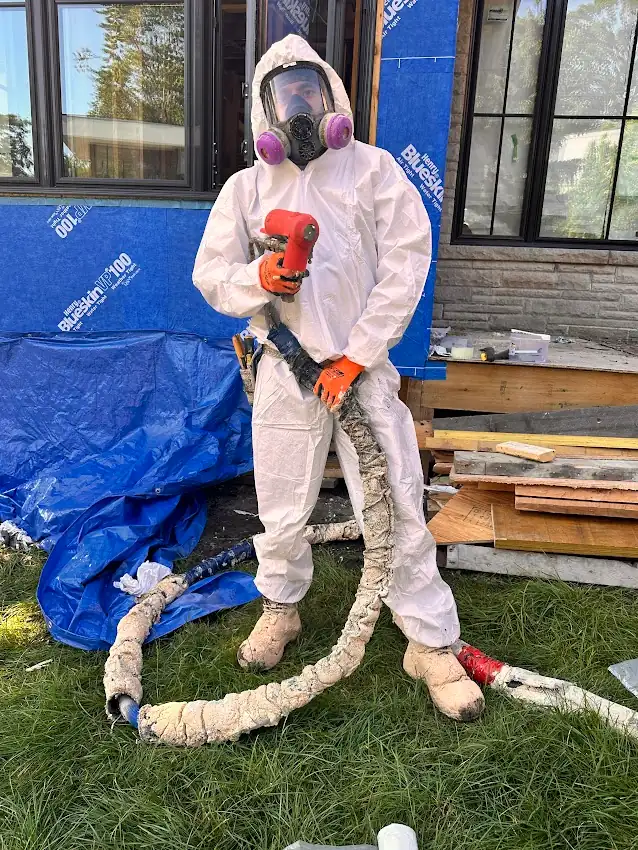
Degreased steel & verified primer compatibility.
Applied on painted steel & galvanized roof/floor decks.
Prevents cohesive or adhesive delamination failure.
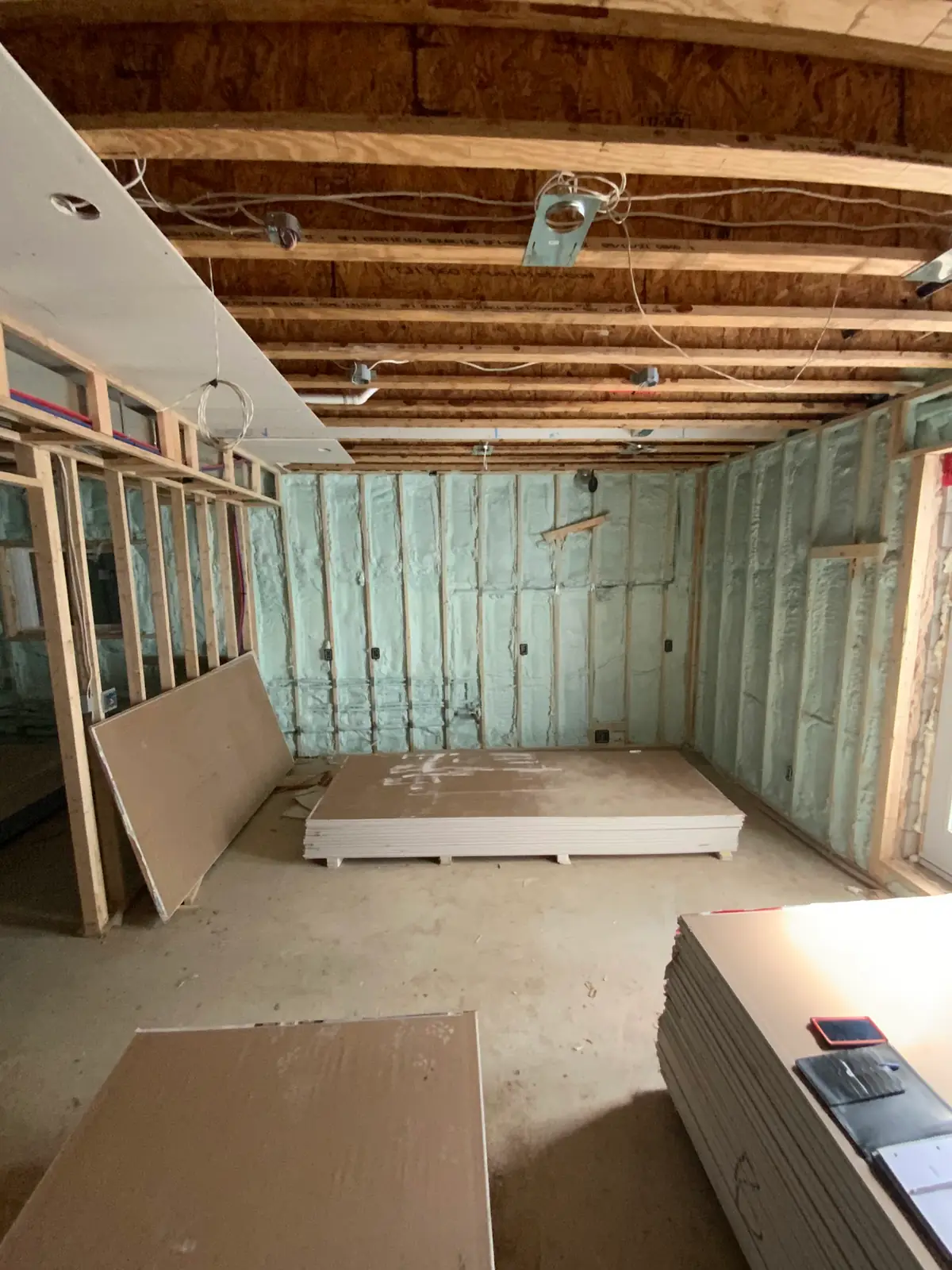
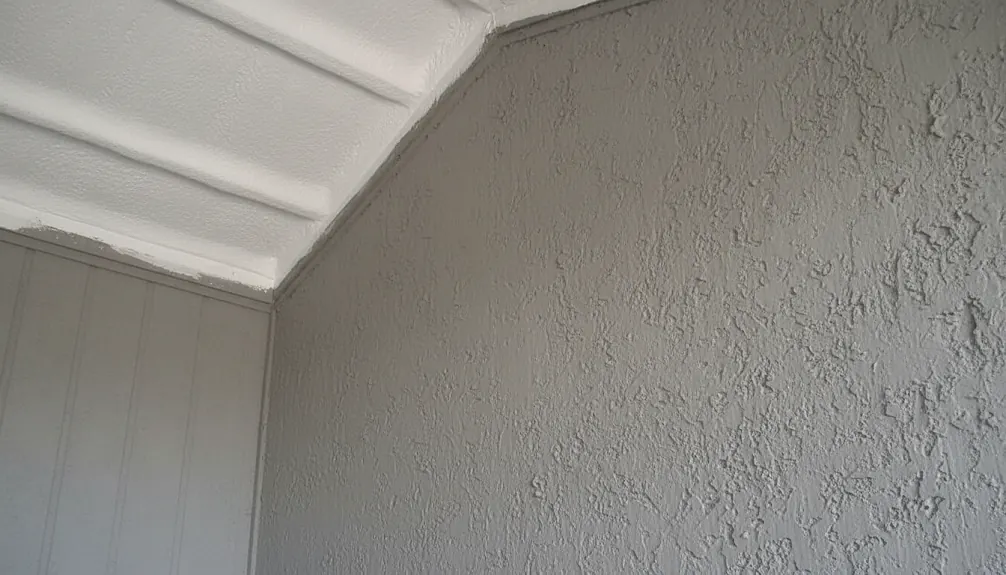
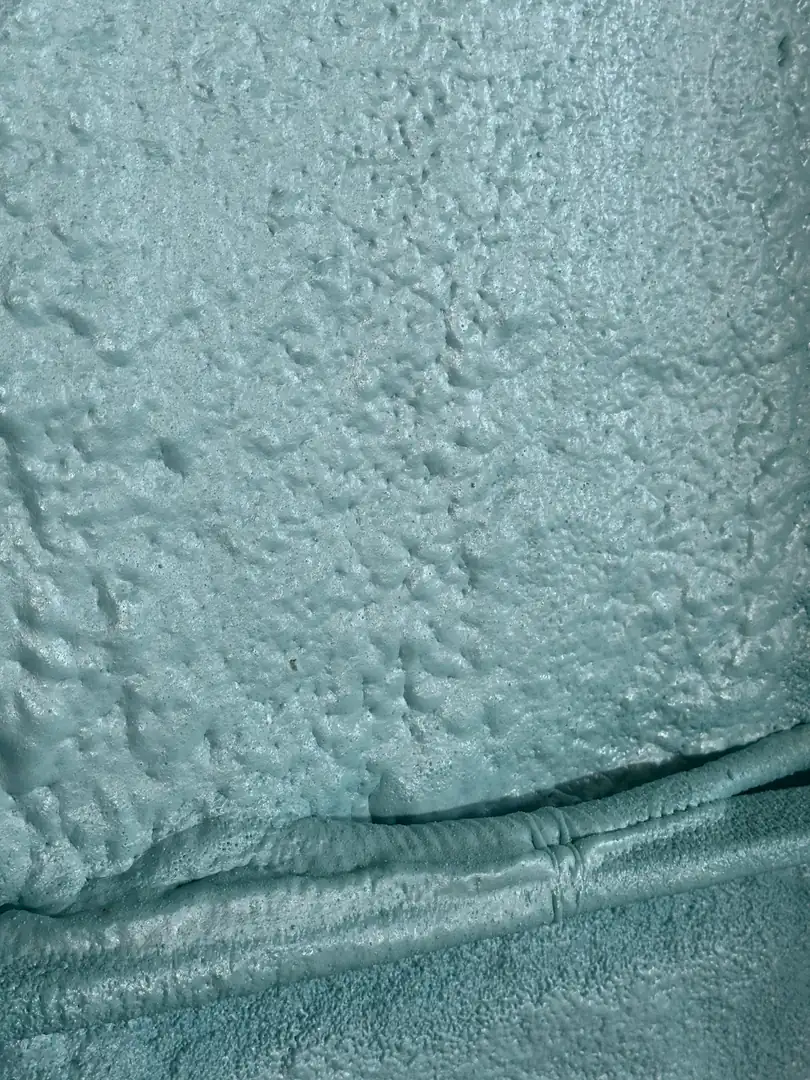
Before a single bag of Monokote or Cafco enters our mixer, our foreman inspects the structural steel for rolling oils, loose mill scale, concrete form-release overspray, and incompatible shop primers. Where required by the ULC listing, we spray a dedicated UL-classified bonding agent so ASTM E736 pull tests exceed code minimums by 30%+.
6 Critical On-Site QA Rules to Prevent Failed ASTM E605 & E736 Fireproofing Inspections in Ontario
Whether we are executing a 40,000 sq ft new structural steel tender or performing commercial cementitious fireproofing patching and occupancy rescue, our engineering team enforces six non-negotiable jobsite rules:
- 1. Never Install Roof Membrane or Mechanical Hangers After SFRM Is Sprayed on the Deck: Under AWCI 12-A and manufacturer warranties, roofers walking on corrugated metal roof decks or concrete pours vibrating floor pans after cementitious fireproofing is applied will shear the
ASTM E736bond interface. Always complete roof ballast/membrane installation and weld all mechanical trapeze clips before SFRM application. - 2. Maintain Substrate & Ambient Temperature ≥4.4°C (40°F) Before, During & 24 Hours After Spraying: If structural steel beams are below
4.4°C (40°F)during an Ontario winter, microscopic ice crystals form at the steel-to-slurry boundary—causing 100%ASTM E736adhesive bond failure once the building warms up. We verify steel temperature with infrared pyrometers and coordinate temporary indirect-fired enclosure heat. - 3. Provide Controlled Natural Ventilation (
4 Air Changes/Hour) During Curing: Cementitious fireproofing (Monokote MK-6,Z-106,Cafco 300/400) releases hundreds of gallons of water vapour as it cures. Stagnant, high-humidity air slows hydraulic set, fosters surface mould, and weakens cohesive strength. - 4. Respect the Strict incompatibility Rule Between SFRM and Spray Polyurethane Foam: Never spray CAN/ULC-S705.1 2 lb closed-cell spray foam directly over low-density gypsum SFRM (
15 pcf), as the exothermic curing heat and tensile pull of polyurethane foam will rip the SFRM off the steel beam. Where exterior wall spray foam meets structural steel, apply SFRM or intumescent coating to the steel first, or use our engineered cutback detail with 18-mil IFTI DC315®. - 5. Specify Medium-Density (
22 pcf) or High-Density (40 pcf) SFRM in Exposed Zones Below 8 Feet: Standard15 pcfSFRM (≥200 psfbond) is engineered only for concealed ceiling plenums above acoustic tile or drywall. In underground parkades, mechanical rooms, and loading docks, specify22 pcf Monokote Z-106 / Cafco 400(≥430 psfbond) or40 pcf Z-146(≥1,000 psfbond). - 6. Schedule Third-Party ASTM E605 / E736 Testing Bay-by-Bay Before MEP Ductwork Goes Up: Waiting until the entire building is framed and ducted to call the third-party testing engineer makes accessing the structural deck 3x more expensive. We coordinate rolling bay-by-bay
ASTM E605 / E736sign-offs while our scissor lifts are still on the floor.
15 lb Standard SFRM vs. 22 lb Medium-Density SFRM vs. Thin-Film Intumescent QA Testing (2026 Comparison)
General contractors and architects frequently ask how field inspection protocols differ between standard cementitious SFRM, Portland-cement medium-density SFRM, and architectural thin-film intumescent steel coatings. Here is the complete 2026 Ontario QA comparison:
| Field QA & Performance Metric | 15 lb Standard SFRM (Monokote MK-6 / Cafco 300) | 22 lb Medium-Density SFRM (Monokote Z-106 / Cafco 400) | Thin-Film Intumescent Mastic (Nullifire / Firetex / SprayFilm) |
|---|---|---|---|
2026 Installed Cost(/sq ft) | $2.25 – $4.10 / sq ft(Lowest cost concealed rating) | $3.15 – $5.25 / sq ft(High-humidity & abrasion spec) | $5.50 – $10.50 / sq ft(Architectural exposed AESS steel) |
Primary Field Test Standard | ASTM E605 (Pin/Core) + ASTM E736(Pull Scale) | ASTM E605 (Pin/Core) + ASTM E736(Pull Scale) | SSPC-PA 2 / AWCI 12-B Magnetic Elcometer DFT Gauge |
Minimum Cured Field Density | ≥ 15.0 lbs / cu ft( 240 kg/m³) | ≥ 22.0 lbs / cu ft ( 352 kg/m³)(40 pcf for Z-146) | Measured by Dry Film Thickness ( 30–145 Mils DFT) |
Minimum ASTM E736 Bond | ≥ 200 lbs / sq ft( 9.5 kPa) | ≥ 430 lbs / sq ft ( 20.6 kPa)(≥1,000 psf for 40 pcf) | > 300–500 PSI( ASTM D4541 Pull-Off Adhesion) |
Destructive Core Patching Needed? | Yes — 3"×3" core holes & 3.25" pull caps must be patched | Yes — Patched with matching Portland-cement SFRM | No — Non-destructive digital magnetic DFT gauge |
Best Ontario Building Zone | Concealed floor/roof decks, joists & shaft beams | Parkades, mechanical penthouses, gyms & unconditioned bays | Exposed lobbies, retail plazas, trusses & custom homes |
Same-Week Commercial SFRM Mixer-Pump & Airless Fire Coating Dispatch Across Toronto & Ontario
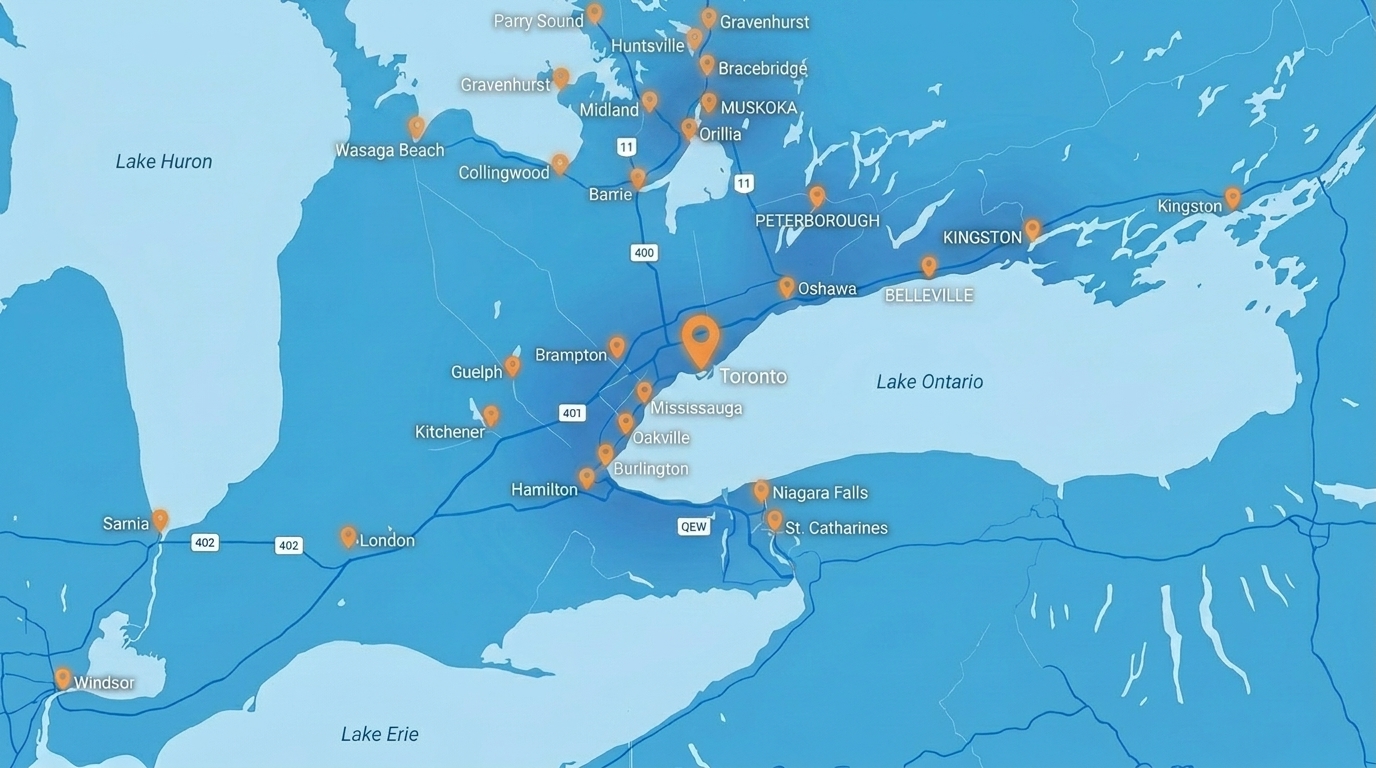
Every commercial cementitious fireproofing, intumescent steel coating, and turnkey 2 lb SPF + 18-Mil DC315 project is executed by our certified Division 07 crews and Caliber Certified (CAN/ULC-S705.2 Licensed) Installers with $0 surrounding GTA travel fee across Toronto, Mississauga, Brampton, Vaughan, Markham, Oakville, Burlington, Hamilton, Pickering, Ajax, Whitby, Oshawa, Milton, and Barrie:

Get an instant ballpark at /price-chat or send structural steel schedules for an exact W/D thickness takeoff.

We verify clean steel/primer, mask MEP equipment, and apply UL-listed bond adhesive on painted steel or decks.

Continuous mixer-pump application of Monokote or Cafco with live nozzle cup-weight and wet-pin depth verification.

We walk the bays with the testing engineer, patch all ASTM E605/E736 test divots, and deliver your QA binder.
Frequently Asked Questions
ASTM E605 is the standard field inspection method used by independent engineering consultants in Ontario to verify the installed pin-depth thickness (in millimetres or fractions of an inch per the specified CAN/ULC-S101 design number) and cured dry density (pcf / kg/m³) of Spray-Applied Fire-Resistive Materials (SFRM). ASTM E736 is the companion field pull-scale test that measures the cohesive and adhesive bond strength (in pounds per square foot, psf) of the cured SFRM to the structural steel beam, column, or fluted metal deck. Contact Sprayfoam Solutions Toronto Inc. at (647) 333-3626 or check your project price at spfsolutions.ca/price-chat.
Under CAN/ULC-S101 and manufacturer listings, standard concealed gypsum SFRM (GCP Monokote® MK-6® HY and Isolatek Cafco® 300) requires a minimum average field density of 15.0 lb/ft³ (240 kg/m³) under ASTM E605 and a minimum bond strength of 200 psf (9.5 kPa) under ASTM E736. Medium-density Portland-cement SFRM (Monokote® Z-106 and Cafco® 400) requires ≥22.0 lb/ft³ (352 kg/m³) density and ≥430 psf (20.6 kPa) bond strength, while high-density industrial SFRM (Monokote® Z-146 and Pyrocrete® 241) requires ≥40.0 lb/ft³ (640 kg/m³) density and ≥1,000 psf (47.9 kPa) bond strength.
In 2026, turnkey commercial CAN/ULC-S101 cementitious fireproofing installed by Sprayfoam Solutions Toronto Inc. costs $2.25 to $4.10 per sq ft for 15 lb standard SFRM, $3.15 to $5.25 per sq ft for 22 lb medium-density SFRM, and $4.25 to $5.85 per sq ft for 40 lb high-density SFRM. If your site has mechanical cut-outs or failed an independent ASTM E605 / E736 audit, our SFRM Deficiency Re-Spray & Patching Service costs $3.50 to $6.50 per sq ft (with a $250 Estimate Credit at spfsolutions.ca/price-chat or (647) 333-3626).
Our commercial Division 07 crews and Caliber Certified (CAN/ULC-S705.2 Licensed) Installers install Isolatek Cafco® 300, GCP Monokote® MK-6® / Z-106, Carboline Pyrocrete® / Nullifire® SC902, Sherwin-Williams Firetex® & other ULC-listed structural fireproofing systems, alongside IFTI DC315® (CCMC #14036-R), No-Burn® Plus ThB, Flame Control No. 60-60A & other approved CAN/ULC-S124 thermal barrier coatings and BASF Walltite® Eco v.3, Huntsman Building Solutions (Icynene/Demilec), Johns Manville & other approved CCMC spray foam chemicals — Low-VOC HFO Blown.
The most common cause of failed ASTM E736 adhesion tests is spraying gypsum-based SFRM directly onto glossy alkyd shop primers, rolling oils, or galvanized floor decking without first applying a ULC-approved latex bonding adhesive (such as Isolatek EBS or A/D Type TC) or spatter-coat. Freezing steel temperatures (<4.4°C / 40°F) during application and roofers walking on the metal deck after spraying also shear the bond interface.
Under Ontario Building Code Division B Part 3 and standard CCDC commercial contracts, the independent third-party materials testing agency (WSP, Pinchin, EXP, Englobe) is retained by the building owner or architect of record to provide unbiased field verification. However, Sprayfoam Solutions Toronto Inc. performs our own internal nozzle cup-weight density checks and wet/dry pin-depth measurements on every bay before calling the consultant inspection—and immediately patches all destructive core divots.
No. Spraying CAN/ULC-S705.1 2 lb closed-cell polyurethane foam directly over 15 pcf or 22 pcf cementitious SFRM violates ULC listings because the exothermic heat and shrinking pull of curing polyurethane foam can delaminate the SFRM from the steel. Because Sprayfoam Solutions Toronto Inc. is a Single-Source Certified Spray Foam & Fire Coating Contractor, we sequence both trades properly using approved thermal cutbacks and 18-mil IFTI DC315® thermal barriers.
General contractors, engineers, and site superintendents can check ballpark pricing and claim a $250 Estimate Credit in 60 seconds at spfsolutions.ca/price-chat (No Site Visit Required), upload structural drawings and ULC schedules through our General Contractor Portal, or call Sprayfoam Solutions Toronto Inc. directly at (647) 333-3626 for same-week GTA dispatch.
Select your commercial fireproofing service hub or local GTA industrial municipality below for 2026 unit rates and same-week dispatch: