Fire Retardant & Intumescent Coatings for Mass Timber, CLT & Exposed Wood in Ontario (2026 OBC & CAN/ULC-S102 Guide)

Fire Retardant & Intumescent Coatings for Mass Timber, CLT & Exposed Wood in Ontario (2026 OBC & CAN/ULC-S102 Guide): 2026 Ontario Overview & Code Essentials
Architects, structural engineers, and commercial developers across Toronto, Mississauga, Vaughan, Ottawa, Waterloo, and Hamilton are specifying Mass Timber—including Cross-Laminated Timber (CLT), Glued-Laminated Timber (Glulam), Nail-Laminated Timber (NLT), and Dowel-Laminated Timber (DLT)—at a record pace in 2026. Yet the moment a commercial project team decides to leave warm, biophilic wood ceilings, columns, or heritage brick-and-beam decking exposed rather than burying them behind two layers of 5/8" Type X gypsum board, municipal plans examiners enforce strict Ontario Building Code (OBC) Division B Part 3 fire-safety thresholds. Without a ULC-listed intumescent fire retardant coating engineered to reduce surface Flame Spread Rating (FSR ≤ 25 under CAN/ULC-S102) or delay structural char depth (CAN/ULC-S101), exposed timber assemblies can trigger costly redesigns or occupancy holds.
At Sprayfoam Solutions Toronto Inc., we serve Ontario general contractors, mass timber fabricators, and commercial property owners as a Single-Source Certified Spray Foam & Fire Coating Contractor operating Caliber Certified (CAN/ULC-S705.2 Licensed) Installers and specialized commercial intumescent airless crews. Whether your project requires an optically clear Class A architectural intumescent finish over Douglas Fir glulam beams, a matte white or charcoal intumescent coating across a heritage timber ceiling, cementitious fireproofing on hybrid steel transfer podiums, or IFTI DC315 thermal barrier coating over perimeter envelope spray foam, we deliver turnkey application and full municipal sign-off binders. Get a $250 Credit on Your Estimate — Check Your Price in 60 Seconds (spfsolutions.ca/price-chat) • No Site Visit Required, or send architectural drawings to our General Contractor & B2B Estimating Desk.
Compare our 3 commercial B2B volume pricing tiers for clear architectural and pigmented CAN/ULC-S102 / S101 timber fire coatings before checking your instant estimate in 60 seconds:
- CAN/ULC-S102 Class A Flame Spread (FSR ≤ 25) Clear or Pigmented Intumescent System
- WFT/DFT Log & Municipal Sign-Off Binder
- Includes $250 Estimate Credit
- Clear Architectural Intumescent Base + Protective Urethane/Silicone Topcoat (or Matte White/Black)
- Passes OBC Part 3 & CAN/ULC-S102 / S101 Char Delay
- Multi-Rig 3,000+ PSI Airless Production
- Hybrid CLT + Structural Steel Intumescent Package (MasterFormat 07 81 23 / 09 96 43)
- Priority GC Tender Rates
2026 Mass Timber, Glulam & Heritage Wood Intumescent Coating Cost Table (Ontario)
In 2026, commercial intumescent fire coating in Ontario for exposed mass timber, Cross-Laminated Timber (CLT) floor slabs, glulam columns, and heritage wood joist ceilings ranges from $3.25 to $8.50 per square foot installed. Pricing is governed by three primary engineering variables: whether the architect specifies an opaque pigmented system (white, light grey, or matte black) versus an optically clear architectural wood-grain system, the required Dry Film Thickness (DFT in mils) to achieve a CAN/ULC-S102 Class A Flame Spread Rating (FSR ≤ 25) or a 45-minute to 2-hour structural fire-resistance upgrade (CAN/ULC-S101), and whether a protective Interior Type B or Humidity-Resistant Topcoat is required:
| Mass Timber / Exposed Wood Scope | Target ULC Fire Standard & Rating | Film Thickness & System Spec | 2026 Installed Rate (/sq ft) | Ontario Building Code Application |
|---|---|---|---|---|
Pigmented White / Black Class A Flame Retardant(Heritage NLT, DLT & Joist Ceilings) | CAN/ULC-S102 Class A ( FSR ≤ 25, SDC ≤ 50) | 12–20 Mils WFT (8–14 Mils DFT) Single/Dual Pass | $3.25 – $4.85 / sq ft | OBC 3.1.13.2 Interior Finish Flame-Spread Reduction |
Clear Architectural Class A Intumescent(Exposed CLT Decks & Glulam Beams) | CAN/ULC-S102 Class A ( FSR ≤ 15–25) Preserving Grain | 16–28 Mils WFT (10–18 Mils DFT) + Clear Sealer Topcoat | $4.50 – $6.75 / sq ft | OBC 3.1.4.8 / EMTC Exposed Mass Timber Ceilings & Columns |
1-Hour to 2-Hour Structural Timber Char Protection(Load-Bearing CLT, Glulam & Trusses) | CAN/ULC-S101 / S146 ( 45-Min to 120-Min FRR) | 35–65+ Mils WFT (22–45+ Mils DFT) High-Build Intumescent | $5.75 – $8.50 / sq ft | Delays Charring ( 0.65 mm/min) & Replaces Type X Drywall |
Hybrid Steel Connectors, Knife Plates & Podium Beams(Mass Timber Steel Nodes) | CAN/ULC-S101 ( 1-Hr to 2-Hr Structural Steel) | 40–110 Mils DFT Thin-Film Steel Intumescent( 07 81 23) | $5.50 – $11.50 / sq ft | Protects Concealed/Exposed Steel Knife Plates & Columns |
Perimeter Spandrel & Roof Deck Turnkey SPF + DC315(Mass Timber Envelope Tie-In) | CAN/ULC-S705.1 + CAN/ULC-S124 ( CCMC #14036-R) | 2.5" – 3.5" 2 lb SPF + 18-Mil WFT IFTI DC315® | $4.25 – $7.50 / sq ft | OBC 3.1.4.2 & SB-10 Monolithic Air/Vapour + Thermal Barrier |
Clear Architectural Intumescent Coatings vs. White or Matte Black Pigmented Timber Coatings
When pricing thin-film intumescent coatings and wood fire retardants for a commercial tender, general contractors and project architects must distinguish between transparent architectural coatings and pigmented intumescent coatings. Both systems intumesce (expand into a thick, microporous carbonaceous foam char at ~200°C / 392°F) to insulate wood fibres from radiant heat and oxygen, but their application physics and material costs differ significantly:
- 1. Clear Architectural Intumescent Wood Coatings ($4.50 – $6.75+ / sq ft): Engineered specifically for showcase Cross-Laminated Timber (CLT) soffits, spruce-pine-fir (SPF) or Douglas Fir glulam columns, and acoustic wood slat lobbies where preserving natural wood grain and knot character is non-negotiable. Clear systems require strict wood moisture verification (
≤12%–15% MC), fine inter-coat sanding preparedness, precise multi-pass wet-film atomization (0.013"–0.017"fine-finish airless tips) to avoid micro-bubbles or milky hazing, and a manufacturer-mandated clear protective topcoat in high-humidity or UV-exposed atrium zones. - 2. White, Grey or Matte Charcoal Pigmented Intumescent Coatings ($3.25 – $4.85 / sq ft): Ideal for Toronto brick-and-beam office conversions, heritage mill renovations (Liberty Village, Distillery District, Hamilton), commercial warehouses, and retail ceilings. Pigmented water-borne or solvent-borne intumescent coatings deliver high hiding power over stained, sandblasted, or uneven historic heavy timber joists, require fewer finish passes, and simultaneously brighten interior workspaces (in high-reflectance White) or conceal overhead MEP conduit (in Architect Matte Black).
- 3. Hybrid Mass Timber + Structural Steel Node Protection: Every modern mass timber building relies on high-strength steel knife plates, tension rods, bearing buckets, and structural steel transfer beams. Because steel loses 50% of its structural yield strength at
538°C (1,000°F)—far faster than heavy timber chars—our crew applies code-matched structural steel intumescent coatings across exposed steel connections during the exact same mobilization.

2026 Ontario Building Code: Encapsulated Mass Timber (EMTC), CAN/ULC-S102 (FSR ≤ 25) & CAN/ULC-S146 Explained
Harmonized updates to the 2026 Ontario Building Code (OBC) Division B Part 3 and the National Building Code of Canada (NBC) have expanded Encapsulated Mass Timber Construction (EMTC) up to 12 to 18 storeys for Group C (Residential) and Group D (Business and Personal Services) occupancies, while also modernizing rules for Heavy Timber Construction (OBC 3.1.4.6) and tall wood hybrid buildings. However, leaving mass timber walls, columns, beams, or CLT ceilings exposed requires satisfying three distinct Canadian fire-testing standards evaluated by ULC and the Canadian Construction Materials Centre (CCMC):
1. CAN/ULC-S102 Surface Flame Spread Rating (FSR ≤ 25) vs. Uncoated Wood (FSR 70–150)
In its natural untreated state, solid Douglas Fir, Spruce-Pine-Fir (SPF), or Cross-Laminated Timber exhibits a CAN/ULC-S102 Flame Spread Rating (FSR) between 70 and 150. While standard rooms in sprinklered buildings allow FSR ≤ 150 on limited percentages of exposed wall or ceiling area, exit stairwells, public corridors, high-occupancy assembly spaces, lobbies, and expanded EMTC exposed ceiling allowances (OBC 3.1.4.8 & 3.1.13.2) frequently mandate an FSR ≤ 25 (Class A) or FSR ≤ 75. Applying a tested clear or pigmented intumescent wood coating (12 to 28 mils WFT depending on wood species and listing) drops the surface Flame Spread Rating to ≤ 15–25—allowing architects to maximize exposed timber percentages legally without installing unsightly gypsum soffits.
2. CAN/ULC-S101 Char-Rate Protection & Protecting CLT Delamination Against Glue-Line Failure
Engineers calculating fire resistance under CSA O86 Annex B rely on wood’s natural charring rate (~0.65 mm/min for one-dimensional charring, or ~39 mm per hour). However, in thin 3-ply or 5-ply Cross-Laminated Timber (CLT) panels or historic underside floor joists, losing 40 mm to 75 mm of sacrificial wood cross-section either requires purchasing much thicker, heavier timber billets or risks heat penetrating to the polyurethane/melamine adhesive glue-line—causing char fall-off and second-wave flashover. A high-build CAN/ULC-S101 intumescent coating expands up to 30x–50x its dry film thickness at 200°C, forming a low-conductivity thermal blanket that delays the onset of wood ignition (300°C isotherm) by 30 to 60+ minutes.
Optically clear architectural fire retardant + topcoat.
Multi-pass fine-finish airless application over ≤12% MC wood.
Preserves 100% natural wood grain & biophilic warmth.
Designed for exposed CLT floor soffits, glulam beams, and feature timber atriums where architects want zero visual concealment. Once exposed to fire (>200°C), the clear film swells into an insulating carbonaceous foam that stops flame propagation and keeps smoke generation below CAN/ULC-S102 Class A limits.
6 Critical Wood Moisture, Substrate Prep & Application Trade Rules for Mass Timber Intumescent Coatings
Applying intumescent fire retardant coatings to living, hygroscopic wood substrates requires fundamentally different field engineering than spraying structural steel or spray foam. If a general painting crew sprays water-based intumescent coating onto wet construction timber or over factory wax sealers, the film will cloud, crack, or delaminate within months. Our certified commercial crews enforce 6 non-negotiable jobsite trade rules on every Ontario mass timber project:
- 1. Pin-Meter Wood Moisture Content Verification (
≤12%–15% MCMandatory Before Spraying): CLT panels and glulam beams delivered to an unheated Ontario jobsite frequently absorb rain and snow melt, pushing internal wood moisture above20%–25%. Spraying clear or pigmented intumescent coatings over wet timber traps moisture vapour, causing milky blushing (in clear coats), osmotic blistering, and checking as the wood shrinks. We test every bay with calibrated Delmhorst pin moisture meters and require≤12% MCfor clear architectural finishes (≤15% MCfor pigmented systems). - 2. Removing Factory Transit Sealers, Mill Glaze, Pitch Bleed & CNC Release Oils: Mass timber fabricators routinely apply sacrificial paraffin wax, penetrating water-repellent transit sealers, or CNC handling oils to protect CLT panels during flatbed shipping. Intumescent coatings cannot bond over wax or oil. Prior to application, we perform cross-hatch adhesion tests (
ASTM D3359), solvent-wipe pitch pockets, and abrade or prime sealed timber surfaces in strict accordance with manufacturer submittals. - 3. Controlling Ambient Temperature (
≥10°C / 50°F), Relative Humidity (<65% RH) & Dew Point: Both water-borne intumescent basecoats and urethane/silicone protective topcoats are highly sensitive to high jobsite humidity during curing. We monitor ambient temperature, substrate temperature (≥3°Cabove dew point), and relative humidity continuously— coordinating temporary desiccant dehumidification or indirect heat so each pass cures crystal-clear without amine blush or micro-foaming. - 4. Multi-Pass Wet-Film Control (
≤8–12 Mils WFT Per Lifton Clear Systems): Attempting to build24 mils WFTof clear intumescent coating in a single heavy pass on overhead CLT soffits causes sags, solvent entrapment, and optical cloudiness. Our technicians use fine-finish low-pressure airless tips (0.013"–0.017") to apply two to three uniform, atomized passes (8–12 mils WFTper pass), verifying each coat with stainless-steel Wet Film Thickness (WFT) notch gauges. - 5. Applying the Mandatory Protective Topcoat for Interior Humidity, UV & Cleaning: Because raw intumescent basecoats are hygroscopic (water-sensitive), leaving an untopcoated intumescent film exposed to high indoor humidity, atrium sunlight, or janitorial wiping will leach out the active intumescent salts over time. We seal every architectural timber assembly with its matched ULC-listed clear matte, satin, or pigmented protective topcoat.
- 6. Coordinating Acoustic Wood Slat, MEP Hanger & Sprinkler Masking Sequence: Mass timber ceilings frequently incorporate CNC-routed acoustic kerfs, black acoustic felt backers, recessed linear LED channels, and exposed brass/chrome sprinkler heads. Under CCOHS and Ontario Ministry of Labour (OHSA) safety protocols, we coordinate whether to pre-coat timber panels at ground level before erection or mask all MEP hangers and sprinkler heads in situ prior to overhead spraying.

Intumescent Fire Coating vs. Type X Drywall Encapsulation vs. Factory FRTW Wood (2026 Comparison)
During value-engineering and code-consulting phases, Ontario architects and general contractors compare three methods for satisfying OBC Part 3 fire regulations on timber structures: Site-Applied Intumescent Fire Coatings, Multi-Layer 5/8" Type X Gypsum Board Direct Encapsulation (see our related DC315 vs. Drywall Thermal Barrier Comparison and Intumescent vs. Cementitious Fireproofing Guide), or Factory Pressure-Impregnated Fire-Retardant-Treated Wood (FRTW). Here is how the three solutions compare in 2026:
| Engineering & Commercial Metric | Site-Applied Intumescent Wood Coating (Clear or Pigmented) | 1 or 2 Layers of 5/8" Type X Gypsum Drywall Encapsulation | Factory Pressure-Treated FRTW Lumber |
|---|---|---|---|
2026 Installed Cost(/sq ft) | $3.25 – $8.50 / sq ft(Single Mobilization) | $6.50 – $12.50 / sq ft(Track, Board, Tape, Mud & Paint) | +$4.00 – $9.00 / bd ft Material Premium + Long Lead Times |
Architectural Biophilic Value | 100% Exposed Wood Grain (Clear) or Sleek Timber Profile | 0% — Completely buries expensive mass timber behind drywall | Often discolours wood & cannot be used on large Glulam/CLT billets |
Dead Load Added to Structure | < 0.12 lbs / sq ft(Virtually Zero Structural Weight) | 2.2 to 4.8 lbs / sq ft(Overloads Heritage Brick-and-Beam Joists) | Adds chemical salt weight; reduces structural design values by 10%–20% |
CAN/ULC-S102 Class A Rating | Yes — Certified FSR ≤ 25 & SDC ≤ 50 on CLT, Glulam & Wood | Yes(Non-combustible gypsum facing, but destroys wood aesthetic) | Limited to dimensional lumber & plywood; fails if sanded/notched on site |
Fastener & Seal Integrity | Seamless monolithic film across compound joints & corners | Hundreds of drywall screws puncture acoustic/vapour layers | Field cuts expose untreated inner wood core during construction |
Schedule Speed(10,000 Sq Ft) | 3 to 5 Working Days(High-Production Airless Crew) | 12 to 20 Working Days(Framers + Boarders + Tapers + Painters) | 6 to 14 Week Kiln-Drying & Autoclave Fabrication Delay |
Same-Week Commercial Intumescent & Hybrid Fireproofing Dispatch Across Toronto & Ontario
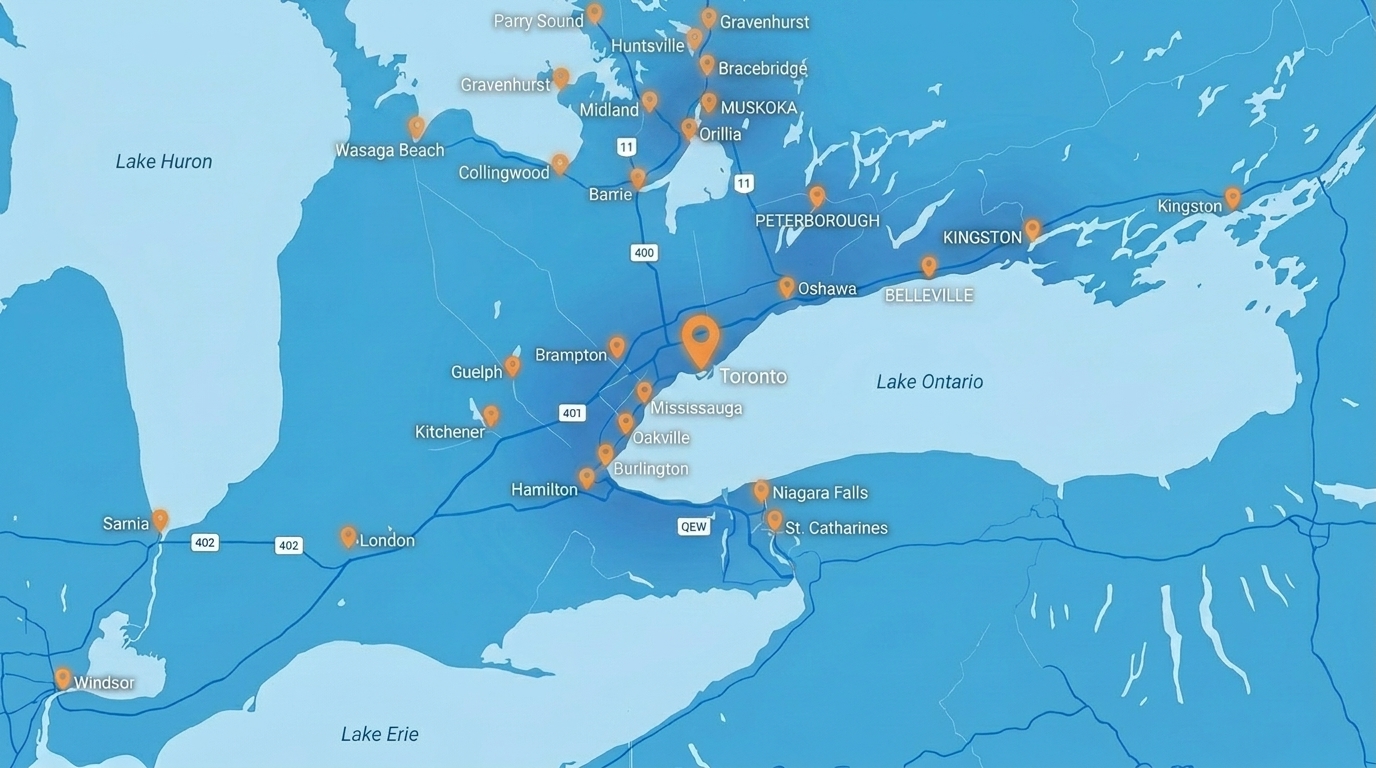
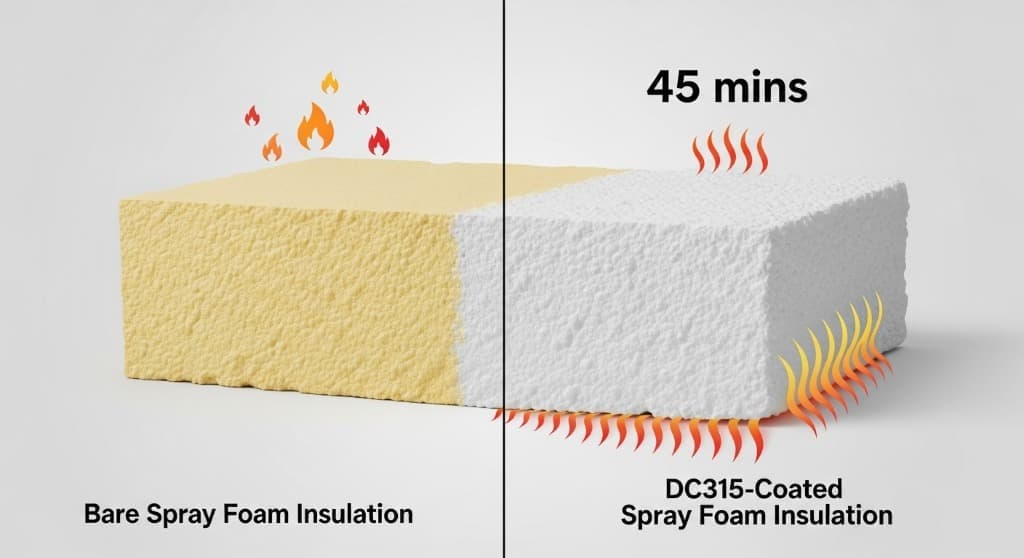
As a Single-Source Certified Spray Foam & Fire Coating Contractor, Sprayfoam Solutions Toronto Inc. eliminates the scheduling friction of hiring separate wood-coating, structural-steel fireproofing, and building-envelope insulation contractors. From a single commercial dispatch with $0 surrounding GTA travel fee, we deploy our certified crews across Toronto, Mississauga, Brampton, Vaughan, Markham, Oakville, Burlington, Hamilton, Waterloo, London, Ottawa, Barrie, and Southern Ontario:

Get an instant ballpark at /price-chat or send RCP/structural schedules for a CAN/ULC-S102 & S101 submittal package.

We pin-test timber moisture, verify adhesion over transit sealers, and mask all glass, steel connections, and sprinklers.

Fine-finish airless application of clear or pigmented intumescent basecoats and protective topcoats to exact mil specs.

We record bay-by-bay WFT/DFT thickness logs, batch numbers, and ULC/CCMC certificates for municipal sign-off.
Frequently Asked Questions
In 2026, certified intumescent fire retardant coatings for Mass Timber, Cross-Laminated Timber (CLT), Glulam beams, and heritage exposed wood in Toronto and Ontario cost $3.25 to $8.50 per square foot installed. Pigmented CAN/ULC-S102 Class A (FSR ≤ 25) flame-retardant coatings average $3.25–$4.85/sq ft, optically clear architectural wood-grain systems with protective topcoats average $4.50–$6.75/sq ft, and high-build CAN/ULC-S101 structural char-protection systems (45-min to 2-hr) average $5.75–$8.50/sq ft. Installed by Sprayfoam Solutions Toronto Inc. ((647) 333-3626), you can check your exact price in 60 seconds and claim a $250 Estimate Credit at spfsolutions.ca/price-chat.
Yes. Sprayfoam Solutions Toronto Inc. installs optically clear, architectural-grade CAN/ULC-S102 Class A intumescent wood coatings paired with clear matte or satin protective sealers. When applied by our certified technicians over timber with ≤12% moisture content using fine-finish airless atomization (16 to 28 mils WFT across controlled passes), the cured film remains transparent—showcasing the natural warmth and grain of Douglas Fir, Spruce-Pine-Fir (SPF), or Western Hemlock while dropping the Flame Spread Rating to FSR ≤ 25 and Smoke Developed Classification to SDC ≤ 50.
This is the most critical distinction in Ontario Building Code Division B Part 3. CAN/ULC-S102 measures how fast flames and smoke travel along the surface of a material during a 10-minute Steiner Tunnel test; achieving Class A (FSR ≤ 25, SDC ≤ 50) allows architects to expose wood in exits, corridors, lobbies, and tall mass timber ceilings (OBC 3.1.4.8 & 3.1.13.2). CAN/ULC-S101 (and CAN/ULC-S146 for encapsulated mass timber) measures how long a structural floor, roof, column, or wall assembly withstands full furnace fire exposure (45 min, 1 hr, or 2 hr) without structural collapse or heat transmission.
As a Single-Source Certified Spray Foam & Fire Coating Contractor, Sprayfoam Solutions Toronto Inc. ((647) 333-3626 • spfsolutions.ca/price-chat) installs full ULC and CCMC compliant product families across steel, timber, and insulation substrates: Isolatek Cafco® 300, GCP Monokote® MK-6® / Z-106, Carboline Pyrocrete® / Nullifire® SC902, Sherwin-Williams Firetex® & other ULC-listed structural fireproofing systems; IFTI DC315® (CCMC #14036-R), No-Burn® Plus ThB, Flame Control No. 60-60A & other approved CAN/ULC-S124 thermal barrier coatings (plus Flame Control No. 10-10A / 20-20A Class A wood systems); and BASF Walltite® Eco v.3, Huntsman Building Solutions (Icynene/Demilec), Johns Manville & other approved CCMC spray foam chemicals.
Yes. Adaptive-reuse conversions of century-old heavy-timber and brick-and-beam buildings in Toronto (Liberty Village, King West, Queen East, Distillery District), Hamilton, and Kitchener-Waterloo frequently face building department orders requiring upgraded flame-spread or fire-resistance ratings on existing wood joists and plank subfloors. Hanging two layers of 5/8" Type X drywall adds nearly 5 lbs/sq ft of dead load and ruins the heritage aesthetic. Spraying a certified clear or matte white/black intumescent wood coating adds <0.12 lbs/sq ft and preserves the exposed timber profile.
Wood is a hygroscopic material that expands and contracts as it equilibrates with indoor heating and cooling cycles. If a contractor sprays an intumescent coating over rain-soaked CLT or glulam panels (>18%–22% moisture content), the trapped water vapour migrates outward as the building is conditioned—causing cloudy white amine blushing under clear coats, pinholing, and bond failure. Our crew tests every bay with calibrated pin moisture meters to confirm ≤12% MC for clear architectural coatings (≤15% MC for pigmented coatings) prior to application.
Yes. Almost every commercial mass timber building in Ontario is a hybrid structure combining CLT/Glulam timber with structural steel transfer beams, wind bracing, and concealed/exposed steel knife-plate connectors, plus insulated perimeter spandrel walls. Rather than hiring three separate sub-trades, general contractors hire Sprayfoam Solutions Toronto Inc. to execute the structural steel intumescent coating, cementitious SFRM, mass timber coating, and turnkey 2 lb closed-cell spray foam + 18-mil DC315 under one unified schedule.
Architects, structural engineers, and general contractors can check instant 2026 square-foot pricing and claim a $250 Estimate Credit in 60 seconds at spfsolutions.ca/price-chat (No Site Visit Required), upload reflected ceiling plans (RCP) and structural schedules through our General Contractor Portal, or call Sprayfoam Solutions Toronto Inc. directly at (647) 333-3626 for same-week commercial site mobilization across Toronto, the GTA, and Ontario.
Select your commercial fire protection division or local Ontario municipality below for 2026 B2B tender rates and same-week dispatch: