Intumescent Steel Fire Coating in Markham: Architect's Guide
Intumescent Steel Fire Coating in Markham: 2026 Ontario Overview & Code Essentials
Thin-film intumescent coating is a paint-like product that swells into a thick insulating char when exposed to heat — protecting structural steel from collapse while keeping the clean, exposed look architects want. If you're designing a project with visible beams and columns in Toronto, Ottawa, or anywhere in Ontario, this is likely the fire protection product your spec will call for.
We're Sprayfoam Solutions Toronto Inc., and we've been applying intumescent fire coatings on exposed steel across Ontario since 2008. Here's the architect's guide to how these coatings work, what the Ontario Building Code requires, and how to spec them correctly.
What Is Thin-Film Intumescent Coating?
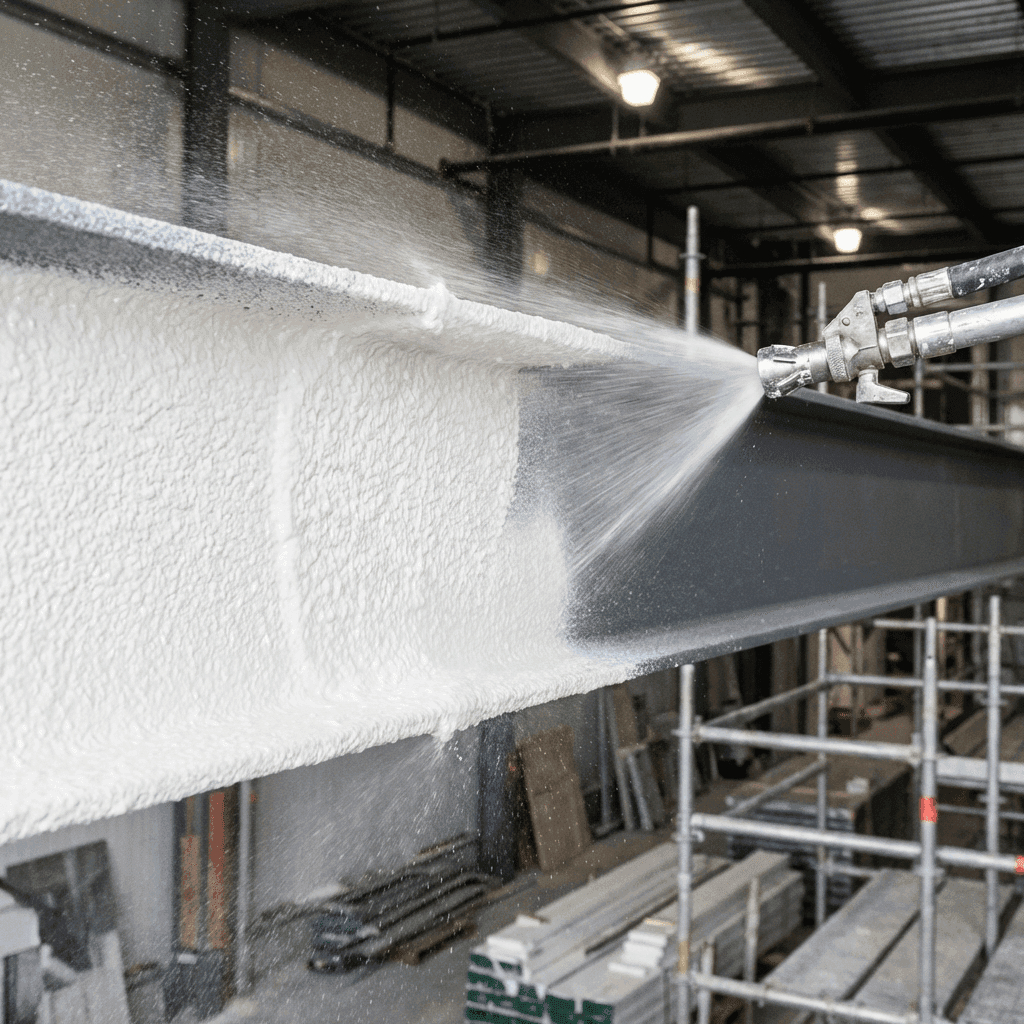
Thin-film intumescent coating goes on like regular paint — typically 0.5 to 2.5 mm of dry film thickness (DFT). At room temperature, it looks and feels like a high-build industrial coating. You can colour-match it to any RAL shade or apply a decorative top coat over it. From across the room, nobody can tell it's fire protection.
The magic happens during a fire. When surface temperatures hit roughly 200–250°C, a chemical reaction starts inside the coating. Three key ingredients — an acid source, a carbon-rich char former, and a blowing agent — react together. The coating expands up to 50 times its original thickness, forming a meringue-like carbon char that insulates the steel underneath.
That char layer keeps the steel below its critical failure temperature for the rated duration — typically 1 or 2 hours under the Ontario Building Code. Once the fire's out, the char can be removed and the steel inspected for structural integrity.
This reaction is what makes intumescent coating the go-to product for architecturally exposed structural steel (AESS). It's the only fire protection method that gives you code-required ratings without covering the steel in 25–50 mm of rough cementitious material. Our team at SPF Solutions applies intumescent fire coating on commercial, institutional, and industrial projects across Ontario — from exposed ceiling beams in Hamilton restaurants to feature columns in downtown Toronto office lobbies.
OBC Fire Rating Requirements for Structural Steel
The Ontario Building Code (OBC) Part 3 sets fire resistance ratings for structural elements based on building height, area, occupancy type, and whether the building's sprinklered. These ratings apply to every load-bearing element — columns, beams, girders, trusses, and their connections.
Here's a simplified breakdown of typical fire ratings you'll encounter on Ontario commercial projects:
| Building Type | Sprinklered | Typical Fire Rating |
|---|---|---|
Commercial up to 6 storeys | Yes | 1 hour |
Assembly / institutional | No | 1.5 hours |
High-rise(7+ storeys) | Yes | 2 hours |
Large unsprinklered assembly | No | 2 hours |
Why does steel need fire protection at all? Steel's strong, but it loses strength fast in a fire. At 550°C, a steel beam retains only about 60% of its load-bearing capacity. At 700°C, that drops to roughly 20%. Without fire protection, an unprotected steel beam in a standard office fire can reach failure temperature in as few as 15 minutes.
Intumescent coatings must be tested to CAN/ULC S101, the Canadian fire endurance test standard. The manufacturer provides engineering listings that specify exactly how thick the coating needs to be for each steel section size and fire rating. Building inspectors in Vaughan, Kitchener, Hamilton, and across Ontario verify these thickness readings on every project.
This is where the W/D ratio matters. The W/D ratio (weight-to-heated-perimeter) of each steel section determines how much coating it needs. A heavy column like a W310x97 has more thermal mass and needs less coating. A lighter section like a W150x22 heats up faster and needs significantly more material to achieve the same 1-hour rating. Your coating contractor should provide a section-by-section thickness schedule before application begins.
DFT Requirements and the Application Process
DFT — dry film thickness — is the single most important quality metric on an intumescent coating project. Too thin, and the steel won't be protected for the full rated duration. The manufacturer's listing specifies exact DFT requirements for every steel section and fire rating combination.
Here's a general sense of DFT ranges — keep in mind these vary by manufacturer and specific steel section:
| Fire Rating | Typical DFT Range | Notes |
|---|---|---|
1 hour | 0.5–1.2 mm | Most common for sprinklered commercial |
1.5 hours | 1.0–1.8 mm | Assembly and institutional |
2 hours | 1.5–2.5 mm | High-rise and unsprinklered |
The application process follows a strict sequence. Skipping steps or cutting corners means the coating won't perform when it matters:
- Surface prep — Steel must be clean, dry, and free of mill scale, rust, and contaminants. Typically SSPC-SP6 commercial blast or equivalent.
- Primer — A compatible primer coat goes down first. The manufacturer's listing specifies which primers are approved — you can't just use any shop primer.
- Intumescent base coats — The intumescent product is applied in multiple coats by airless spray, building up to the required DFT. Each coat needs to dry before the next goes on.
- DFT verification — Wet and dry film thickness readings are taken at specified intervals across every beam and column. These readings become part of the project's inspection documentation.
- Decorative top coat — A compatible top coat is applied for colour, UV protection, and durability. This is where the architect picks their finish colour.
Our crew provides DFT documentation and inspection reports for every project. For architects and code officers reviewing a specification, we're happy to walk through the compliance documentation — learn more about our intumescent fire coating service.
Intumescent vs Cementitious vs Encasement
Architects have three options for structural steel fire protection. Here's the honest comparison — each one has a place depending on whether the steel's visible or hidden:
| Factor | Thin-Film Intumescent | Cementitious SFRM | Concrete Encasement |
|---|---|---|---|
Appearance | Smooth, paint-like finish | Rough, grey, textured | Bulky concrete cover |
Thickness | 0.5–2.5 mm | 15–50 mm | 50–100 mm |
Weight added | Minimal | Moderate | Heavy |
Aesthetic impact | None — looks painted | Hides the steel | Completely hides the steel |
Repair ease | Touch-up with brush | Re-spray damaged areas | Form and pour |
Best for | Exposed steel(AESS) | Concealed steel | Parking garages, heavy industrial |
Pricing | Project-specific | Project-specific | Project-specific |
For concealed steel behind drywall or above suspended ceilings, cementitious fireproofing is the standard. It's well-understood by inspectors, widely available, and straightforward to apply. There's no reason to pay for the smooth finish of intumescent when nobody sees the steel.
But for any AESS application — offices in Waterloo, restaurants in Guelph, loft-style spaces in Toronto — intumescent is the only realistic option. Concrete encasement works for parking structures and heavy industrial, but it adds significant weight and completely defeats the exposed aesthetic. For a deeper comparison, read our intumescent vs cementitious fireproofing breakdown.
Where Architects Specify Thin-Film Intumescent
You'll find intumescent-coated exposed steel in just about every project type where the design intent is “show the structure.” Here are the applications we see most often across Ontario:
- Restaurants and breweries — Exposed ceiling beams and bar-area columns are standard in industrial-chic dining spaces across Toronto, Hamilton, and Ottawa.
- Loft-style offices — Open ceilings with painted mechanical and exposed steel are a staple in converted warehouse offices and modern co-working spaces.
- Retail spaces — Big-box and boutique retail with high exposed ceilings often leave steel visible for aesthetic and cost reasons.
- Institutional lobbies and atriums — University buildings, libraries, transit stations, and municipal buildings frequently feature AESS with intumescent coatings.
- Mixed-use developments — Ground-floor commercial with exposed structural elements is common in new mixed-use projects in Waterloo, Guelph, and across the GTA.
In every case, the architect specifies intumescent because it's the only product that delivers the fire rating without compromising the design. You can read more about structural steel fire rating requirements in Ontario for a deeper look at how OBC Part 3 applies to these building types.
Pricing for Intumescent Fire Coating in Ontario
Intumescent fire coating pricing is project-specific. The cost depends on variables that change from building to building:
- Fire rating — Moving from a 1-hour to a 2-hour rating roughly doubles the required coating thickness and material volume.
- Steel section sizes — Lighter W/D sections need more material per square foot of coverage.
- Total steel area — Larger projects spread mobilization costs across more square footage.
- Access conditions — Standard scaffolding vs boom lifts vs swing staging all affect labour rates.
- Colour and top coat — Custom colour matching or high-performance decorative top coats add to the scope.
- Phasing — Working around other trades in occupied or partially occupied spaces increases labour time.
Because of these variables, we don't publish a flat per-square-foot rate for intumescent coatings. Every project gets a custom assessment based on the actual steel schedule, site conditions, and required fire rating. Contact us for a detailed, project-specific quote.
We're WSIB compliant with $5M liability insurance — required for most GC and institutional projects across Ontario. We only apply products with current CCMC evaluations and provide complete documentation packages for every project.
Frequently Asked Questions About Thin-Film Intumescent Coating
Yes. Thin-film intumescent coatings accept compatible decorative top coats that can be tinted to virtually any RAL colour or Benjamin Moore shade. The top coat sits over the intumescent layer and provides the final visual finish. Our team coordinates colour matching with your architect's specification.
Interior intumescent coatings are designed to last the life of the building when properly applied in climate-controlled environments. They don't degrade over time under normal conditions. Exterior applications may need a UV-resistant top coat and periodic inspection. We recommend visual checks during routine building maintenance.
Yes. Once the coating activates and forms its protective char, it's consumed in the process. After a fire event, the char is removed, the steel's inspected for structural integrity, and new intumescent coating is applied to restore the fire rating. This is standard procedure on any fire-damaged structure.
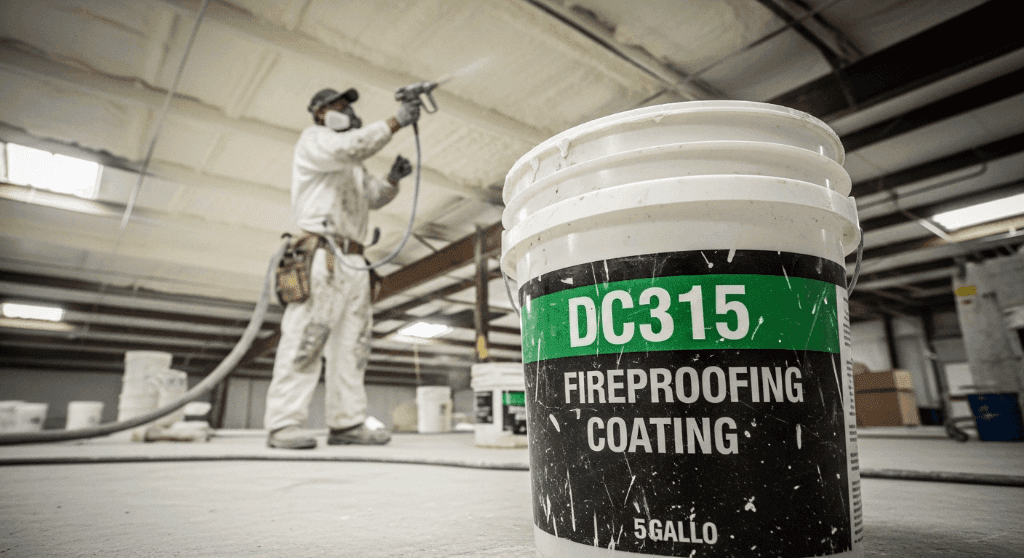
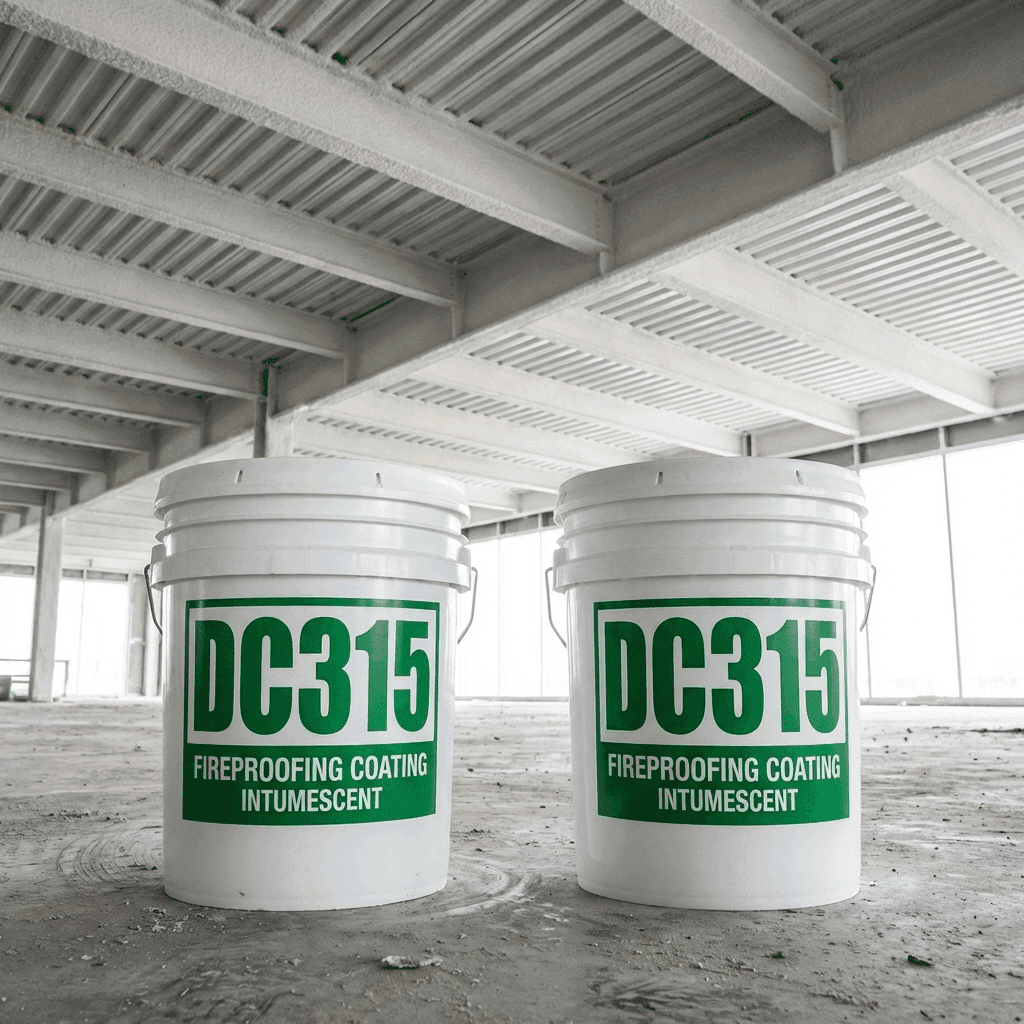
No. DC315 is an intumescent coating designed for spray foam insulation — it serves as an ignition or thermal barrier alternative. Structural intumescent coatings are entirely different products tested to CAN/ULC S101 for steel fire protection. They serve different code requirements.
DFT is dry film thickness — measured after the coating cures. WFT is wet film thickness — measured during application. Contractors use WFT gauges during spraying to estimate whether the dried coating will meet the required DFT. Final DFT readings taken with calibrated gauges are what building inspectors review for code compliance.
Protect Your Exposed Steel — The Right Way
Thin-film intumescent coating lets you meet OBC fire ratings without hiding the steel you designed to be seen. Whether it's a 1-hour rating on a restaurant beam in Hamilton or a 2-hour rating on a high-rise column in Toronto, the product delivers code compliance with a clean, architectural finish.
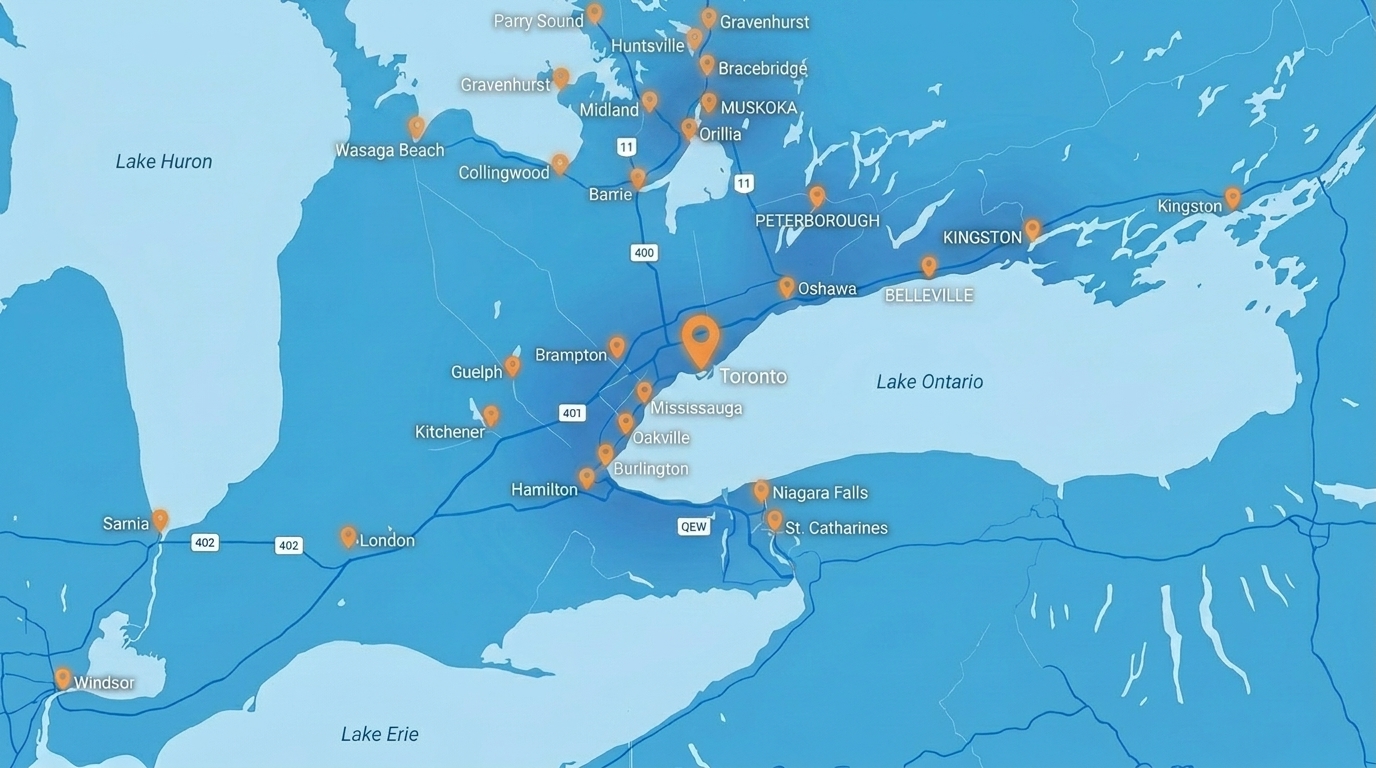
Need a project-specific quote? Call us at 647-333-3626 or email info@spfsolutions.ca. We serve all of Ontario — Toronto, Ottawa, Hamilton, Waterloo, Guelph, and everywhere in between.